

CNL (Chronic Neutrophilic Leukemia) Explained: Symptoms, CSF3R Gene Testing & Treatment Options in India
At a Glance
- Sample Required: Peripheral blood (2-3 mL) or bone marrow aspirate
- Fasting Rules: None required
- Turnaround Time (TAT): 7-10 working days
- Base Cost: [Insert Current 2026 Price]
Written by [Your Name] | Medically Reviewed by [Specialist] | Last Updated: [Date]
Understanding CSF3R-Related Neutrophilia
A persistently high neutrophil count is one of the most common findings on a routine blood report — and one of the most commonly misread. Most clinicians default to infection, inflammation, or a reactive process. But there are two other explanations that are far rarer, far more specific, and both come down to the same gene: CSF3R.
One is Chronic Neutrophilic Leukemia (CNL) — a rare, acquired blood cancer. The other is Hereditary CSF3R Neutrophilia — a familial trait present from birth. They can look identical on paper. Telling them apart changes everything about how a patient and their family are counseled, monitored, and treated. This piece walks through both, in sequence, starting with the acquired form.
Part 1: Chronic Neutrophilic Leukemia (CNL)
What Is CNL?
CNL belongs to a family of blood cancers called myeloproliferative neoplasms (MPNs) — conditions where the bone marrow produces too many of a particular blood cell type. In CNL's case, the overproduced cell is the neutrophil, the immune system's frontline defender against infection.
Unlike chronic myeloid leukemia (CML), which is driven by the well-known Philadelphia chromosome and the BCR-ABL1 fusion gene, CNL is BCR-ABL1-negative. This distinction matters enormously for diagnosis: CNL can look like a bad infection or a reactive high white count on a routine blood report, and it's often only correctly identified after other causes have been ruled out and specific genetic testing is done.
CNL is genuinely uncommon. Only around 200 cases had been formally reported worldwide as of 2019, and the true global incidence remains unknown. Most patients are diagnosed around age 66, with a slight male predominance.
Symptoms to Watch For
CNL's presentation ranges from completely silent to significantly symptomatic:
- No symptoms at all — many cases are caught incidentally on a routine complete blood count (CBC)
- Enlarged spleen (splenomegaly) — the single most consistent physical finding, sometimes causing abdominal fullness, bloating, or early satiety
- Enlarged liver (hepatomegaly)
- Fatigue
- Itching (pruritus)
- Easy bruising, bleeding tendencies, or purpura
- Bone pain
- Gout, in some cases
Indian case reports have also highlighted an elevated serum vitamin B12 level as a recurring laboratory clue alongside persistent neutrophilia — a detail worth flagging for clinicians reviewing unexplained high white counts.
The Genetic Driver: CSF3R Mutations
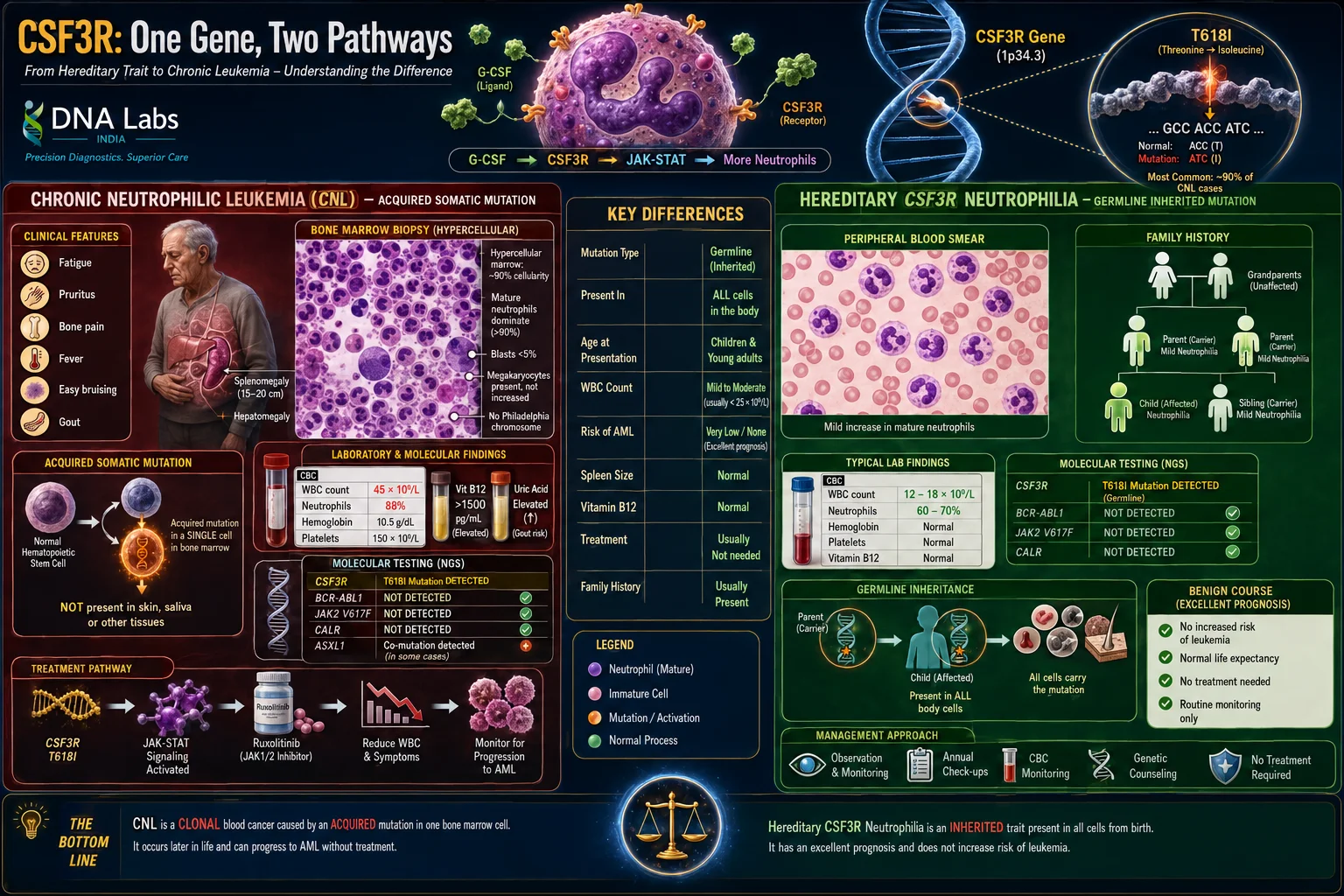
The single most important advance in CNL research has been the discovery of activating mutations in CSF3R — the gene encoding the receptor for granulocyte colony-stimulating factor (G-CSF). About 90% of CNL patients carry a CSF3R mutation, most commonly the specific variant CSF3R T618I.
Why does this matter clinically?
- It confirms the diagnosis. WHO 2022 criteria require either a demonstrated CSF3R mutation or, in its absence, persistent neutrophilia for at least three months plus splenomegaly with no other identifiable cause.
- It predicts drug response. Depending on exactly where the mutation sits on the CSF3R gene, the cancer cells signal either through the JAK-STAT pathway (sensitive to JAK inhibitors like ruxolitinib) or through SRC-family/TNK2 kinases (sensitive to dasatinib instead). In other words, the mutation subtype can tell doctors which targeted drug is more likely to work — a textbook example of precision medicine in a rare cancer.
- It carries prognostic weight. CSF3R T618I-driven CNL tends to behave more aggressively than CNL driven by other CSF3R variants, and co-occurring mutations (such as ASXL1) further worsen the outlook.
How Is CNL Diagnosed?
Because CNL mimics far more common conditions, diagnosis is a careful process of exclusion:
- Rule out reactive causes: infection, inflammation, and other secondary triggers of neutrophilia
- Rule out other MPNs: CML, polycythemia vera, primary myelofibrosis
- Confirm counts: white blood cell count typically ≥25 × 10⁹/L (or ≥13 × 10⁹/L under newer ICC criteria for CSF3R-mutated cases), with neutrophils making up ≥80% of the count and fewer than 10% immature precursor cells
- Bone marrow examination: hypercellular marrow dominated by mature neutrophilic cells, with blasts under 5%
- Molecular testing: CSF3R mutation analysis, alongside BCR-ABL1 testing to exclude CML
Prognosis
CNL is an aggressive disease despite its chronic-sounding name. Median overall survival after diagnosis is approximately 1.8 years, and 10–20% of patients eventually transform to acute myeloid leukemia (AML), typically within 3–94 months (average around 21 months) of diagnosis.
Treatment: Where We Stand Today
Because CNL is so rare, there is no single globally standardized treatment protocol — but a clear treatment philosophy has emerged over the last decade, formalized in guidelines such as Onkopedia's CNL treatment algorithm.
Conventional approaches:
- Cytoreductive drugs like hydroxyurea to control white cell counts
- Targeted chemotherapy in select cases
- Allogeneic stem cell transplantation — currently the only potentially curative option, generally reserved for younger, fit patients
The targeted therapy shift: The discovery of CSF3R mutations transformed CNL from a disease managed purely by symptom control into one where genotype can guide therapy. A landmark case described dramatic clinical improvement in a CSF3R-mutated CNL patient treated with the JAK1/2 inhibitor ruxolitinib — a finding that led to a formal Phase II clinical trial.
That trial (published in the Journal of Clinical Oncology) tested ruxolitinib in 44 patients with CNL and atypical CML. The results confirmed that ruxolitinib was more active in CNL than in atypical CML, and activity was strongest in patients carrying the CSF3R T618I mutation — direct evidence that mutation testing should inform treatment choice.
Researchers have also explored JAK1-selective inhibitors and dasatinib as alternatives tailored to the specific CSF3R mutation subtype (membrane-proximal vs. truncation mutations), reinforcing that CNL treatment is moving toward a genotype-first model.
It's worth noting this isn't a fully solved problem: case reports describe patients with co-occurring CSF3R and SETBP1 mutations showing resistance to ruxolitinib, and clonal evolution during treatment has been documented — meaning ongoing molecular monitoring matters even after treatment starts.
The India Context
CNL remains exceptionally rare in Indian clinical practice, and most of the published Indian literature consists of individual case reports rather than large cohort studies — including reports from centers like B.J. Medical College, Pune, describing the classic CNL triad of splenomegaly, sustained neutrophilic leukocytosis, and elevated vitamin B12, with cytogenetic confirmation ruling out CML.
India does not yet have a distinct national CNL treatment protocol; management generally follows the international WHO/ICC diagnostic framework and Onkopedia treatment guidance. Ruxolitinib is already approved and available in India for other MPNs (myelofibrosis, polycythemia vera), making off-label use feasible in confirmed CSF3R-mutated CNL cases where a specialist deems it appropriate — though robust India-specific outcome data is still limited.
What has changed meaningfully in recent years is access to molecular diagnostics. Next-generation sequencing and targeted mutation panels — including CSF3R testing — are increasingly available through Indian diagnostic laboratories, no longer requiring samples to be sent overseas. This matters because CNL's diagnosis and treatment selection both hinge on getting this specific genetic test done early and accurately.
The Takeaway
CNL illustrates a broader shift in hematology: a disease that used to be managed by "wait and control symptoms" is increasingly approached as "test the mutation, then match the drug." For patients with unexplained, persistent high neutrophil counts and splenomegaly, timely CSF3R mutation testing isn't just a diagnostic checkbox — it's the step that opens the door to targeted therapy options like ruxolitinib.
Part 2: Hereditary CSF3R Neutrophilia — When a High Neutrophil Count Runs in the Family
Most doctors are trained to interpret a persistently high neutrophil count as one of a handful of things: an infection, an inflammatory flare, a reaction to medication, or — in the rare worst case — an acquired blood cancer like the CNL described above. There is a fourth possibility that gets missed far more often than it should: the neutrophilia was never acquired at all. It was inherited.
Hereditary CSF3R neutrophilia is a distinct, familial condition in which a mutation in the CSF3R gene is present from birth — passed down through generations — rather than arising spontaneously later in life the way it does in CNL. Recognizing this distinction changes how a family gets counseled, monitored, and tested.
Two Very Different Ways to Get the Same Mutation
The CSF3R gene encodes the receptor for granulocyte colony-stimulating factor (G-CSFR), the signal that tells the bone marrow to keep producing neutrophils. When this gene carries an activating mutation, the receptor essentially gets stuck signaling "make more neutrophils" even without the normal trigger.
There are two distinct routes to this same molecular outcome:
| Feature | Somatic (Acquired) | Germline (Hereditary) |
|---|---|---|
| Origin | Arises later in life within a single clone of bone marrow cells | Present in every cell from conception, inherited or new mutation |
| Inheritance | Not passed to children | Can be passed to next generation |
| Clinical Presentation | Often with splenomegaly, high WBC, may be symptomatic | May be asymptomatic or mild, often familial pattern |
| Diagnosis | Requires exclusion of reactive causes and other MPNs; CSF3R mutation testing | Family history, germline testing, often incidental |
| Treatment | Targeted therapy (e.g., ruxolitinib) based on mutation subtype; possible transplant | Usually no treatment needed; monitoring and genetic counseling |
The clinical picture can look almost identical at a glance — high white cell count, neutrophil-dominant differential, sometimes an enlarged spleen — which is exactly why family history and genetic testing are the only reliable ways to tell them apart.
The Genetics: Not All CSF3R Mutations Behave the Same Way
Research has identified more than one hereditary CSF3R variant, and where the mutation sits on the gene matters enormously:
- CSF3R T618I (also referenced as T595I in some older nomenclature) is the most extensively studied variant. It has been documented as a spontaneous germline mutation in children, and — importantly — it is the same mutation seen in somatic CNL. However, germline T618I mutations are rare and may present with a milder phenotype.
- Other germline variants such as CSF3R Q741X and other truncating mutations have been reported in families with hereditary neutrophilia. These often lead to a truncated receptor that is constitutively active but may respond differently to targeted inhibitors.
The distinction between somatic and germline CSF3R mutations is critical for genetic counseling. If a patient has a germline mutation, family members may be at risk, and predictive testing should be offered. In contrast, somatic mutations are not inherited.
Clinical Implications and Family Counseling
For families with hereditary CSF3R neutrophilia, the condition is often benign and does not require treatment. However, it is essential to avoid unnecessary investigations and anxiety. Genetic counseling should explain the autosomal dominant inheritance pattern, the low risk of progression to leukemia (if any), and the importance of monitoring blood counts periodically.
In contrast, CNL is a malignant disorder that requires prompt management. The presence of a CSF3R mutation in a patient with persistent neutrophilia should prompt a thorough workup to differentiate between the two.
The Takeaway
CNL and hereditary CSF3R neutrophilia represent two ends of the same genetic spectrum. While CNL is a rare acquired malignancy with a poor prognosis if untreated, hereditary neutrophilia is often benign. The key to accurate diagnosis lies in comprehensive genetic testing, including CSF3R mutation analysis, and careful clinical correlation. In India, access to such testing is improving, enabling precision medicine approaches for patients with unexplained neutrophilia.
If you or a family member have persistent high neutrophil counts, consult a hematologist or medical geneticist. DNA Labs India offers ISO 9001 certified CSF3R gene testing with rapid turnaround times to guide diagnosis and treatment decisions.