

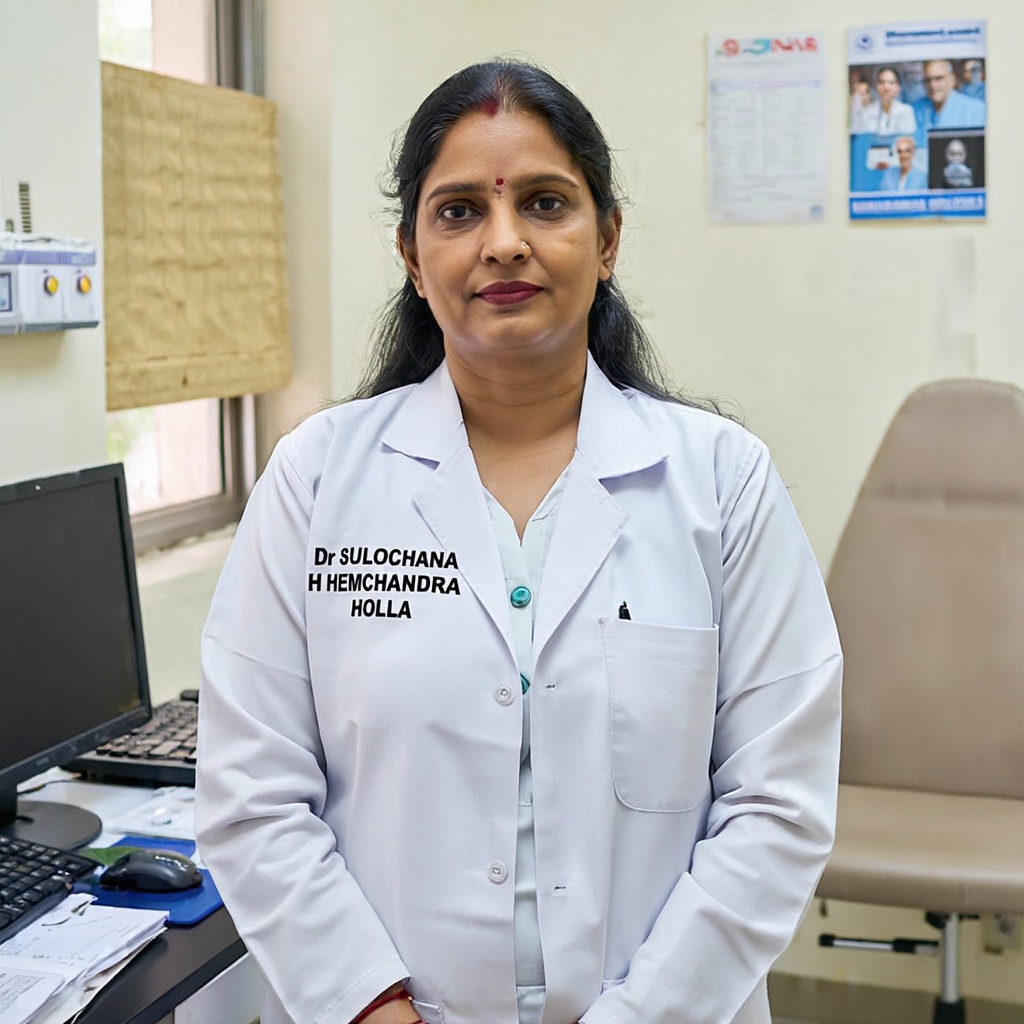
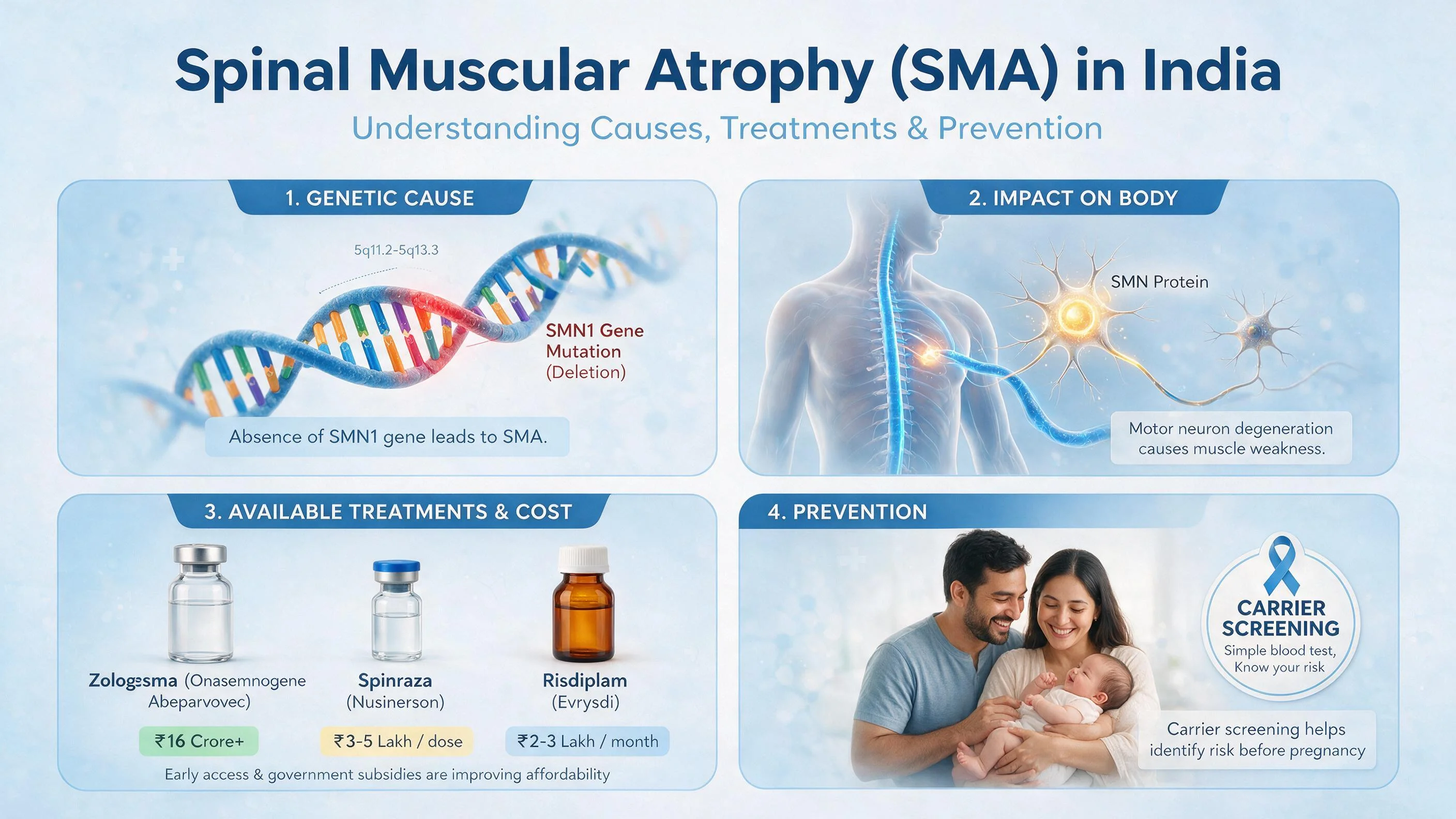
Medical infographic illustrating Spinal Muscular Atrophy in India showing SMN1 gene mutation on a DNA helix, motor neuron degeneration in the spinal cord, cost comparison of Zolgensma Spinraza and Risdiplam treatments with Indian rupee symbols, and a family undergoing carrier screening.

Spinal Muscular Atrophy in India:
Symptoms, Genetic Testing, and the Truth About Gene Therapy Costs

⚕️ Every year, Indian news cycles carry the same wrenching story: parents racing to crowdfund ₹16–18 crore for a single injection. This guide covers the biology, the real numbers, and what families need to know.

Spinal Muscular Atrophy (SMA) is an inherited neuromuscular disorder that damages the motor neurons in the spinal cord, affecting the ability to sit, walk, swallow, and eventually breathe. The root cause is a faulty or missing SMN1 gene, inherited in an autosomal recessive pattern. A child is affected only if they inherit a non-working copy from both parents.

Humans also carry a nearly identical backup gene, SMN2, which produces the same protein but in smaller amounts. The number of SMN2 copies largely determines severity — more backup copies generally mean a milder course.

The Four Types of SMA

TypeOnsetTypical Course
Type 1 (most severe)Before 6 monthsCannot sit unsupported; historically fatal in infancy without treatment
Type 26–18 monthsCan sit but not walk independently
Type 3After 18 months (childhood)Can walk initially; may lose the ability over time
Type 4 (mildest)AdulthoodMild muscle weakness, normal lifespan

Early signs in infants include a “floppy” body, weak cry, difficulty feeding, and delayed motor milestones. In older children: frequent falls, waddling gait, or trouble climbing stairs.

How Common Is SMA in India, Really?

📊 Carrier frequency in North India: ~1 in 38 (slightly higher than global average of 1 in 40–50).

Because it’s recessive, most carriers never know unless tested. SMA is the second most common fatal autosomal recessive disorder worldwide. In India, high carrier rates combined with consanguineous practices in some communities increase the risk.

There is a diagnostic gap: India does not yet have universal newborn SMA screening, so diagnosis is often delayed — sometimes until a family has already lost one child.

How Genetic Testing Identifies SMA

  • Diagnostic testing (symptomatic child): looks for homozygous deletion of exon 7 in SMN1 — confirms SMA with high accuracy.
  • Carrier screening (healthy adults, before/during pregnancy): identifies one non-working copy; most SMA cases occur with no family history.
  • SMN2 copy number analysis: helps predict severity and guides treatment.
  • Prenatal & preconception counselling: when both partners are carriers, genetic counselling walks through the 25% risk per pregnancy.

The Truth About Gene Therapy Costs

There are three major SMA-modifying treatments globally. Below is an honest, no-spin look at the numbers in India.

  • 🧬 Zolgensma (onasemnogene abeparvovec) — one-time gene therapy, approved for children under 2.
    ₹16–18 crore per dose. Imported, highly specialised viral-vector tech. Manufacturer’s global compassionate-access program has closed.
  • 💉 Spinraza (nusinersen) — spinal fluid injection; loading phase + lifelong maintenance.
    ~₹87 lakh per injection; lifetime cost can exceed Zolgensma’s one-time price.
  • 💊 Risdiplam (Evrysdi) — oral liquid, the only one currently approved by India’s CDSCO for standard prescription.
    ~₹6 lakh per bottle, ongoing dosing based on age/weight.

📌 2025 Delhi High Court ruling

Allowed an Indian generic manufacturer to produce its own version of Risdiplam, potentially bringing costs down dramatically for the estimated ~2 lakh SMA patients in India.

For now, most Indian families facing an SMA diagnosis must choose between crowdfunding, compassionate-access applications, or the oral option.

Why Prevention Matters More Than the Headlines Suggest

Because the vast majority of SMA cases occur in couples with no family history, carrier screening is the only tool to catch this risk in advance. If you’re planning a pregnancy, have a family history of unexplained infant muscle weakness, or simply want clarity, genetic counselling and SMN1 carrier testing are worth an honest conversation with a genetics specialist.


Frequently Asked Questions

1. What is Spinal Muscular Atrophy (SMA) and what causes it?
SMA is an inherited neuromuscular disorder that damages motor neurons, leading to progressive muscle weakness. It is caused by a faulty or missing SMN1 gene, inherited in an autosomal recessive pattern (both parents must pass on a non-working copy).
2. What are the early symptoms of SMA in infants and children?
In infants: “floppy” body (hypotonia), weak cry, feeding difficulties, delayed motor milestones. In older children: frequent falls, waddling gait, difficulty climbing stairs.
3. How common is SMA in India compared to the rest of the world?
Carrier frequency in North India is roughly 1 in 38, slightly higher than the global average of 1 in 40–50. An estimated 10–24 infants are born with SMA every day in India.
4. How is SMA diagnosed through genetic testing?
Diagnosis is confirmed by testing for homozygous deletion of exon 7 in the SMN1 gene. Carrier screening identifies healthy carriers; SMN2 copy number predicts severity.
5. Is there a cure for SMA, and what treatments are available in India?
There is no universal cure, but three disease-modifying treatments exist: Zolgensma (gene therapy), Spinraza (spinal injections), and Risdiplam (oral liquid). Risdiplam is the only one approved by India’s CDSCO for routine prescription.
6. Why does SMA gene therapy (Zolgensma) cost ₹16–18 crore in India?
The cost reflects complex manufacturing with specialised viral-vector technology, small-batch production, and import costs — no generic economies of scale.
7. Can SMA be prevented, and what is the role of carrier screening?
Yes — preconception carrier screening for both partners identifies the 25% risk per pregnancy. The Society for Indian Academy of Medical Genetics recommends universal carrier screening for all couples.
8. What is the difference between the SMA treatments available in India?
Zolgensma: one-time IV for children under 2 (~₹16–18 crore). Spinraza: lifelong spinal injections (~₹87 lakh/dose). Risdiplam: daily oral liquid (~₹6 lakh/bottle), and the only CDSCO-approved option for routine prescription.

🧬 SMA India · 29 July 2026

Free Home Sample Collection

For all online bookings

100% Accurate Results

We dont use any chinese reagents

No Compramise with quality

NGS test Platform is Illumina Nova seq

Get Tested at India No1 DNA Lab

Call us now to get free genetic counselling