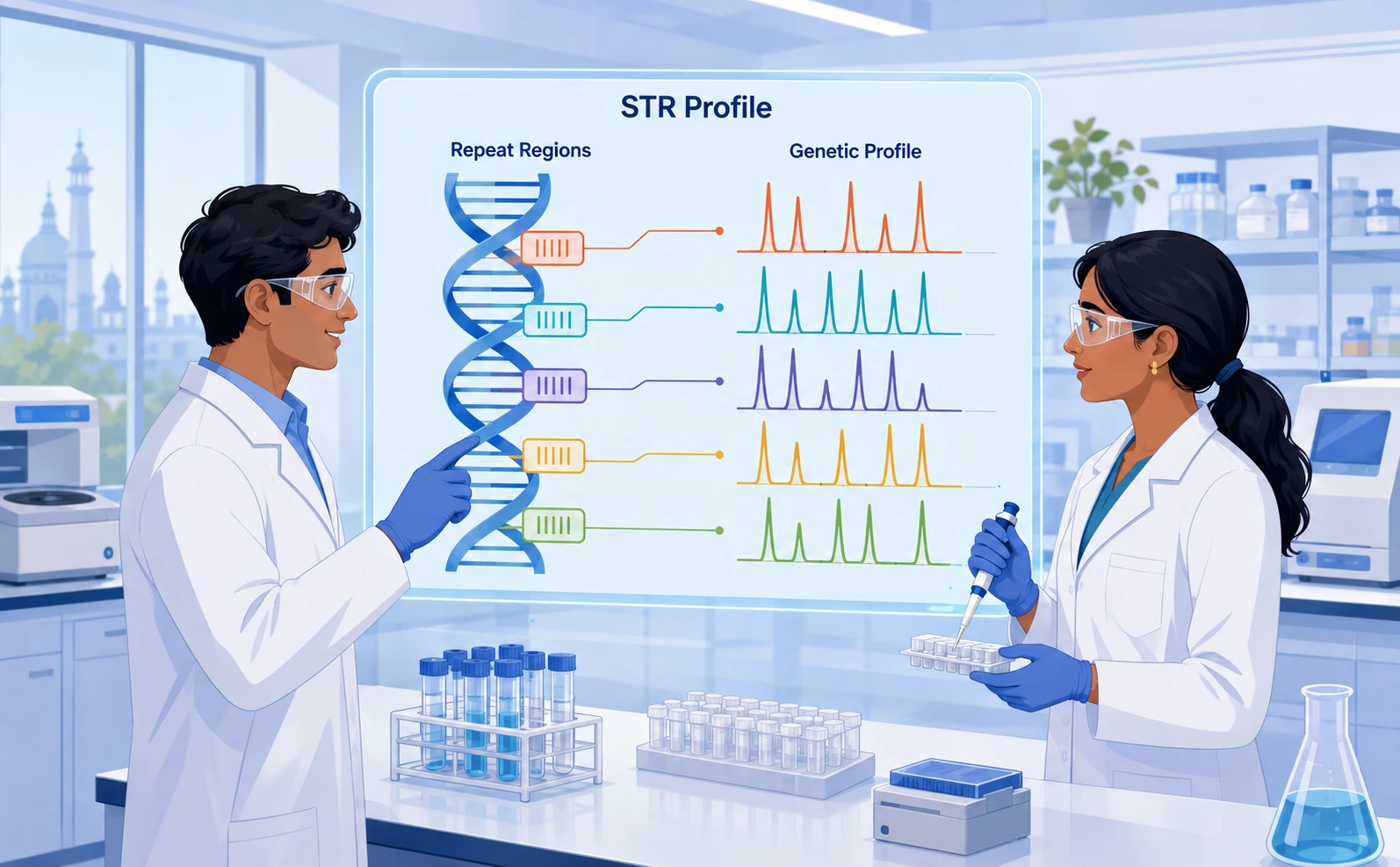
ndian lab technicians analyzing a DNA double helix converting into an STR genetic barcode

What Is a Single DNA Profile? The Science Behind the STR Fingerprint That Protects Indian Research

Every human cell carries a genetic signature that no other person on earth shares — except an identical twin. When a laboratory extracts that signature into a readable, comparable format, the result is called a single DNA profile: one definitive genetic fingerprint tied to one biological source.

It sounds like a simple idea. In practice, it is the single most important quality-control checkpoint in modern biomedical research — and one that a growing number of Indian labs, biotech startups, and pharmaceutical companies are still learning to build into their workflow.

What “Single DNA Profile” Actually Means

A single DNA profile is not a photograph of your entire genome. It is a targeted readout of specific locations on your DNA called Short Tandem Repeats (STRs) — short sequences of DNA bases that repeat a variable number of times at fixed points across the genome.

The number of repeats at each location differs from person to person, and from one biological source to another. By reading 16 to 21 of these locations simultaneously, a lab converts a biological sample into a string of numbers — a profile — that functions like a barcode. Using 16 STR markers, the probability of two unrelated biological sources randomly sharing the same profile is approximately 1 in 10^22. For context, that is a number many times larger than the total count of cells in the human body.

This is why STR analysis, not visual inspection or general PCR testing, is treated as the reference method for confirming identity — whether the “identity” in question belongs to a person, a tissue sample, or a laboratory cell line.

Why This Matters Beyond the Individual: The Cell Line Identity Crisis

Most people think of DNA profiling in the context of paternity or forensics. But the same underlying science — generating one authoritative profile per source — is now central to a problem that has quietly cost global research billions of rupees: cell line misidentification.

A cell line is a population of cells grown in culture and reused across experiments, sometimes for decades. If a cell line becomes cross-contaminated with another line, or was mislabeled at its source, every experiment built on top of it inherits a false foundation.

The scale of this problem is not anecdotal:

  • In an analysis of 482 human tumor cell lines, up to 96 were found to be misidentified through STR profiling, and combining STR with species verification revealed that over 20% of the lines had been incorrectly identified.
  • A separate investigation of 278 widely used tumor cell lines found that 46% showed cross-contamination or misidentification when compared against the ATCC and DSMZ reference databases.
  • A 2013 review of more than 200 biomedical papers found that only 43% of the cell lines referenced could be uniquely and correctly identified.
  • One widely cited estimate attributes roughly $3.5 billion in cumulative research spending to work built on just two misidentified cell lines — HEp-2 and INT 407 — which were later confirmed to actually be HeLa cells.

None of this happens because researchers are careless. It happens because a cell line’s identity can drift silently — through cross-contamination in a shared incubator, a mislabeled vial, or genetic changes that accumulate over hundreds of passages. Without periodically generating a fresh, single DNA profile and checking it against the original reference, there is no way to know.

Why This Is an India-Specific Conversation Now

India’s contract research, biotech, and pharmaceutical sectors have expanded rapidly over the past decade, with more academic and industry labs than ever maintaining their own cell culture banks for cancer research, drug screening, and stem cell work. That growth brings the same identity-management risk that more mature research ecosystems have already had to confront.

Two forces are pushing Indian labs to formalize this step rather than treat it as optional:

1. Journals and funding bodies increasingly require it. Peer-reviewed journals are now asking authors to describe their cell line authentication procedures — including the STR profiling or molecular methods used to verify identity — and to specify what testing ruled out contamination before a manuscript is even accepted for review. Some research institutions have gone further, making authentication of every cell line a mandatory requirement prior to manuscript submission.

2. Biological material in India is subject to regulatory oversight. The Indian Council of Medical Research (ICMR) sets guidelines governing biological material samples, working alongside approvals from the CDSCO and other national and state-level authorities. A properly documented, single, unambiguous DNA profile for each biological asset a lab works with is foundational to staying compliant as that oversight tightens.

For an Indian lab exporting data, publishing internationally, or partnering with a global pharmaceutical company, a defensible single DNA profile on file is quickly becoming table stakes rather than a nice-to-have.

How a Single DNA Profile Is Actually Generated

The process behind a reliable single-source DNA profile follows a consistent scientific pipeline, regardless of whether the sample is a cheek swab, a tissue biopsy, or a flask of cultured cells:

  1. DNA extraction — genetic material is isolated and purified from the biological sample.
  2. Multiplex PCR amplification — multiple STR locations are copied and amplified simultaneously using fluorescently labeled primers.
  3. Capillary electrophoresis — the amplified fragments are separated by size on a genetic analyzer, generating a distinct peak pattern for each STR marker.
  4. Profile generation and comparison — the resulting numeric profile is compared against a known reference. For cell lines, that reference is typically the source donor sample or an established cell bank record, such as the databases maintained by ATCC and DSMZ.

A match confirms the sample’s identity. A mismatch — even a partial one — signals contamination, mislabeling, or genetic drift that needs to be investigated before the sample is used for further work.

Beyond Cell Lines: Where a Single Profile Approach Applies

While cell line identity is one of the fastest-growing applications in India’s research sector, the same “one profile, one source” principle underlies several other areas of biological verification:

  • Biobank and repository record-keeping, where a documented reference profile allows samples to be tracked and re-verified over years of storage.
  • Reference sample creation, where a known, unambiguous profile is generated once and used as the benchmark for all future comparisons.
  • Research reproducibility audits, where labs re-confirm the identity of long-standing cultures before starting a new grant-funded study.

In every case, the value is the same: a single, unambiguous genetic fingerprint removes guesswork from a process where guessing has historically been very costly.

The Standard Cell Lines Are Held To

Because a single mismatched profile can invalidate years of work, the scientific community has converged on formal benchmarks rather than leaving authentication to individual judgment. The ATCC Standards Development Organization’s ASN-0002 guideline, for instance, recommends a minimum panel of 8 STR loci for human cell line authentication — though many labs now test well beyond that minimum for greater discriminatory power, particularly when working with sensitive material like human embryonic stem cell lines. Results are typically cross-checked against the two largest public STR reference repositories, maintained by ATCC and DSMZ, which together catalog thousands of known cell line profiles.

This is also why species-level checks are often paired with STR data: research has shown that STR profiling alone cannot rule out inter-species cross-contamination, meaning a cell line can return a technically correct human STR profile while still containing a hidden fraction of contaminating cells from another species. A rigorous authentication protocol accounts for this gap rather than relying on a single test in isolation.

Building Identity Verification Into Your Research Workflow

A single DNA profile is only useful if it exists — and if it is refreshed at the right moments. Best practice across the cell biology community suggests generating or re-confirming a profile:

  • When a new cell line is first established or received from an external source
  • Before freezing a stock for long-term storage
  • Whenever a lab works with more than one cell line simultaneously, to rule out cross-contamination
  • Before starting a new experiment on a line that has been in continuous culture for an extended period

Treating this as a routine checkpoint, rather than a one-time formality, is what separates research groups whose data survives peer review and replication from those whose findings quietly unravel later.

Verifying Cell Line Identity With DNA Labs India

DNA Labs India generates STR-based genetic profiles for human cell lines, stem cell cultures, and xenografts, comparing results against established reference databases to confirm — or flag discrepancies in — a cell line’s identity. If your lab is establishing a new line, preparing for publication, or simply due for a periodic identity check, our Cell Line Authentication DNA Test applies this exact single-profile methodology to your samples.

Frequently Asked Questions

Is a single DNA profile the same as a full genome sequence? No. A single DNA profile reads a targeted set of STR markers chosen specifically for their ability to distinguish one source from another — it is not a comprehensive readout of an individual’s entire genetic code.

How often should a research lab re-check a cell line’s profile? At minimum, when the line is first acquired, before long-term freezing, and periodically during extended continuous culture — since genetic drift and cross-contamination can both occur silently over time.

Can two different cell lines ever share the same STR profile by coincidence? With enough STR markers analyzed, the odds are astronomically small. This is precisely why standards bodies recommend testing a minimum panel of loci rather than relying on just one or two markers.

Free Home Sample Collection

For all online bookings

100% Accurate Results

We dont use any chinese reagents

No Compramise with quality

NGS test Platform is Illumina Nova seq

Get Tested at India No1 DNA Lab

Call us now to get free genetic counselling