
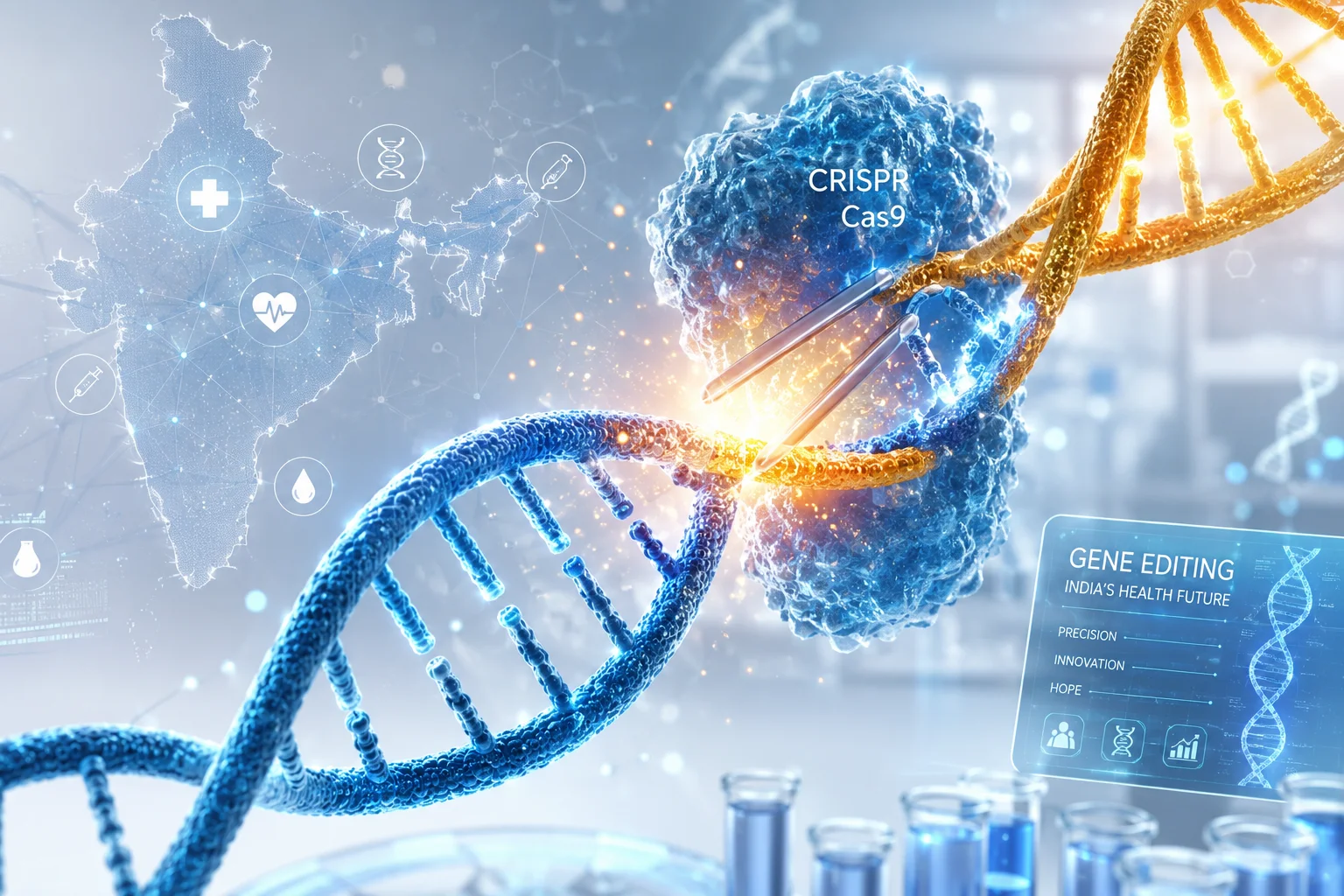
Understanding the CRISPR Revolution
Imagine having the ability to edit the fundamental code of life—the DNA that dictates everything from our eye color to our susceptibility to disease. This is not science fiction. It is the reality of CRISPR-Cas gene editing, a groundbreaking technology that has transformed the landscape of genetics and medicine.
CRISPR, an acronym for Clustered Regularly Interspaced Short Palindromic Repeats, represents one of the most significant scientific breakthroughs of the 21st century. In simple terms, it acts as a pair of “genetic scissors” that can precisely cut DNA at specific locations, allowing scientists to add, remove, or alter genetic material. This biological mechanism was originally discovered as a part of the immune system in bacteria and archaea, which use it to remember and defend against invading viruses . In the laboratory and clinic, scientists have repurposed this system to correct genetic defects, study gene function, and develop novel therapies.
In India, the CRISPR Cas genes market has seen significant activity, with a compound annual growth rate (CAGR) of -22.7% from 2020 to 2024, indicating a dynamic and consolidating market environment . The technology is being explored across various sectors, including human therapeutics, agriculture, and industrial use, with research focuses on gene therapy, pest-resistant crops, and synthetic biology . This technology also holds immense potential for understanding hereditary diseases. For those concerned about the hereditary nature of conditions like cancer, genetic screening can help identify inherited mutations .
How CRISPR-Cas9 Gene Editing Works
To understand how CRISPR works, it is helpful to break down its mechanism, which occurs in three main stages: adaptation, expression, and interference.
Adaptation (The Memory Stage)
When a virus invades a bacterium, the bacterium uses a Cas protein to capture a small piece of the virus’s DNA. This piece is then stored in the bacterium’s own genome within the CRISPR array, acting as a “memory” of the infection .
Expression (The Preparation Stage)
The CRISPR array containing these “memory” sequences is transcribed into a long RNA molecule, which is then processed into smaller, mature CRISPR RNAs (crRNAs). Each crRNA contains a guide sequence that can recognize and bind to a matching viral DNA sequence. In the case of the widely used CRISPR-Cas9 system, the crRNA is fused with a tracrRNA (trans-activating CRISPR RNA) to form a single guide RNA (sgRNA) . This sgRNA is the component that directs the Cas9 protein to the correct location on the DNA.
Interference (The Cleavage Stage)
The Cas9 protein, guided by the sgRNA, scans the DNA for a sequence that matches the guide RNA. Once a match is found, the Cas9 protein creates a double-strand break in the DNA at that precise location .
This break triggers the cell’s natural DNA repair mechanisms. There are two primary repair pathways:
- Non-Homologous End Joining (NHEJ): This error-prone pathway often results in insertions or deletions (indels) of genetic material at the cut site. This can effectively “knock out” a gene, which is useful for studying gene function or disrupting disease-causing genes.
- Homology-Directed Repair (HDR): This is a more precise repair pathway that can be harnessed to introduce new genetic material. If a DNA template containing a desired sequence is provided alongside the CRISPR machinery, the cell may use this template to repair the break, effectively inserting or correcting a specific gene .
The Evolution of CRISPR Cas Gene Technology
Since its initial discovery, the CRISPR-Cas system has diversified into a powerful toolkit with multiple variants. The most commonly known is Cas9, but scientists are also utilizing other proteins like Cas12 and Cas13, each with unique properties for DNA targeting, RNA targeting, or virus detection .
Cas Variants and Functions
| Cas Type | Primary Function | Key Applications |
|---|---|---|
| Cas9 | DNA Targeting | Gene knockout, gene correction, basic research |
| Cas12 | DNA Targeting | Gene editing, diagnostics |
| Cas13 | RNA Targeting | RNA knockdown, viral diagnostics |
Beyond Gene Editing
The precision of CRISPR has also led to the development of “dead” Cas proteins (dCas9) which can bind to DNA without cutting it. This allows scientists to:
- Activate Gene Expression (CRISPRa): Turn on specific genes.
- Repress Gene Expression (CRISPRi): Turn off specific genes without altering the DNA sequence.
This approach is invaluable for studying gene regulation and developing therapies for diseases that require modulation of gene activity rather than permanent editing .
Tackling Delivery Challenges
One of the greatest hurdles in gene therapy is delivering the CRISPR components to the right cells in the body. Researchers are exploring various methods to address this, including:
- Viral Vectors: Using modified viruses (like adeno-associated viruses or lentiviruses) to carry the CRISPR machinery into cells .
- Nanoparticles: Using lipid nanoparticles (LNPs) or other synthetic materials to package and deliver the components, which can reduce the risk of immune reactions and off-target effects .
- Other Non-Viral Methods: Including electroporation and hydrodynamic delivery .
Real-World Clinical Applications in India
Indigenous Gene Therapy for Sickle Cell Disease
Perhaps the most significant recent milestone for CRISPR technology in India is the launch of the country’s first indigenous CRISPR-based gene therapy for Sickle Cell Disease (SCD) .
The therapy, named “BIRSA 101” —in honor of the tribal freedom fighter Bhagwan Birsa Munda—marks a historic step towards making advanced gene-editing cures accessible and affordable in India . Sickle cell disease is a genetic blood disorder that particularly affects India’s tribal population and can cause severe pain, organ damage, and stroke . India sees an estimated 30,000–40,000 children born with the disorder every year .
The therapy was developed at the CSIR–Institute of Genomics & Integrative Biology (IGIB) and involves a public-private partnership with the Serum Institute of India to ensure the therapy reaches those who need it most . The technology uses an engineered enFnCas9 CRISPR platform to precisely correct the genetic mutation that causes sickle cell disease . Unlike the globally approved Casgevy therapy, which costs over USD 2.2 million, the indigenous development aims to provide a potential permanent cure at a fraction of the cost . The researchers are now also working on developing a therapy for thalassemia using the same platform .
Extending the Reach of Biotechnology
To further accelerate the translation of CRISPR research into real-world clinical applications, the Jawaharlal Nehru Centre for Advanced Scientific Research (JNCASR) and CrisprBits have signed a Letter of Intent to establish a Centre of Excellence for CRISPR Innovation and Translation (CoE-CIT) in Bengaluru . This center will bridge the gap between laboratory discoveries and clinical deployment, serving as a national model for public-private partnerships in biotechnology .
CRISPR Technology in Medical Diagnostics and Research
Beyond therapeutics, CRISPR is revolutionizing diagnostics, an area often referred to as theranostics—combining therapy and diagnosis . Diagnostic applications use CRISPR’s ability to detect specific DNA or RNA sequences, which can be harnessed to create rapid, low-cost, and highly sensitive tests for pathogens or genetic mutations .
In research, CRISPR has become an essential tool. It is widely used in proteomics (the study of proteins), enabling scientists to investigate protein-protein interactions, protein-chromatin interactions, and to develop biological models for diseases . This research is critical for identifying new biomarkers, finding druggable targets for cancer, and developing new therapeutic approaches. CRISPR has been used to create numerous genetically modified animal models for studying gene function, including mice, zebrafish, and Drosophila .
The Future of Gene Editing in India
The path for CRISPR technology is both exciting and challenging. While the technology offers unprecedented potential to cure genetic diseases and improve agriculture, scientists are actively working on overcoming challenges including:
- Off-target Effects: Preventing unintended edits elsewhere in the genome remains a primary focus. AI-guided experimental design and novel Cas variants are being developed to enhance specificity .
- Delivery Efficiency: Improving the safe and efficient delivery of CRISPR components to specific tissues is a key research area .
- Immunogenicity: Reducing the immune response to the Cas proteins and delivery vectors .
Despite these challenges, the future of CRISPR in India is bright. As the country continues to invest in indigenous innovation and foster public-private partnerships, CRISPR technology holds the key to a new era of accessible, precision healthcare, aligning with the vision of a “Sickle Cell–Free India by 2047” . By continuing to develop homegrown solutions, India is establishing itself as a global leader in the development of affordable and effective gene-editing technologies.
FAQ
What is CRISPR gene editing?
CRISPR is a revolutionary gene-editing technology that allows scientists to make precise changes to DNA. It acts like “genetic scissors” that can cut and edit genes to correct defects or study their function.
What is the CRISPR-Cas9 system?
The CRISPR-Cas9 system is the most common and well-studied version of the technology. It consists of a Cas9 protein that can cut DNA and a guide RNA that directs the protein to the specific gene sequence that needs to be edited.
How is CRISPR technology being used in India?
India has recently made significant strides in using CRISPR for therapeutics. A notable example is the development of the indigenous CRISPR-based gene therapy ‘BIRSA 101’ for Sickle Cell Disease. Research is also being conducted in agriculture and diagnostics .
Is CRISPR gene therapy safe?
While promising, CRISPR therapy has risks, including potential “off-target” effects where unintended genes are edited. Scientists are actively researching and developing safer, more precise methods to minimize these risks.
What diseases can CRISPR cure?
CRISPR has the potential to cure a wide range of genetic diseases. The current focus includes blood disorders like sickle cell disease and thalassemia, as well as inherited forms of blindness, certain cancers, and other monogenic (single-gene) disorders.
Disclaimer: This content is for educational purposes only and is not intended as a substitute for professional medical advice, diagnosis, or treatment. Always seek the advice of your physician or other qualified health provider with any questions you may have regarding a medical condition.

