
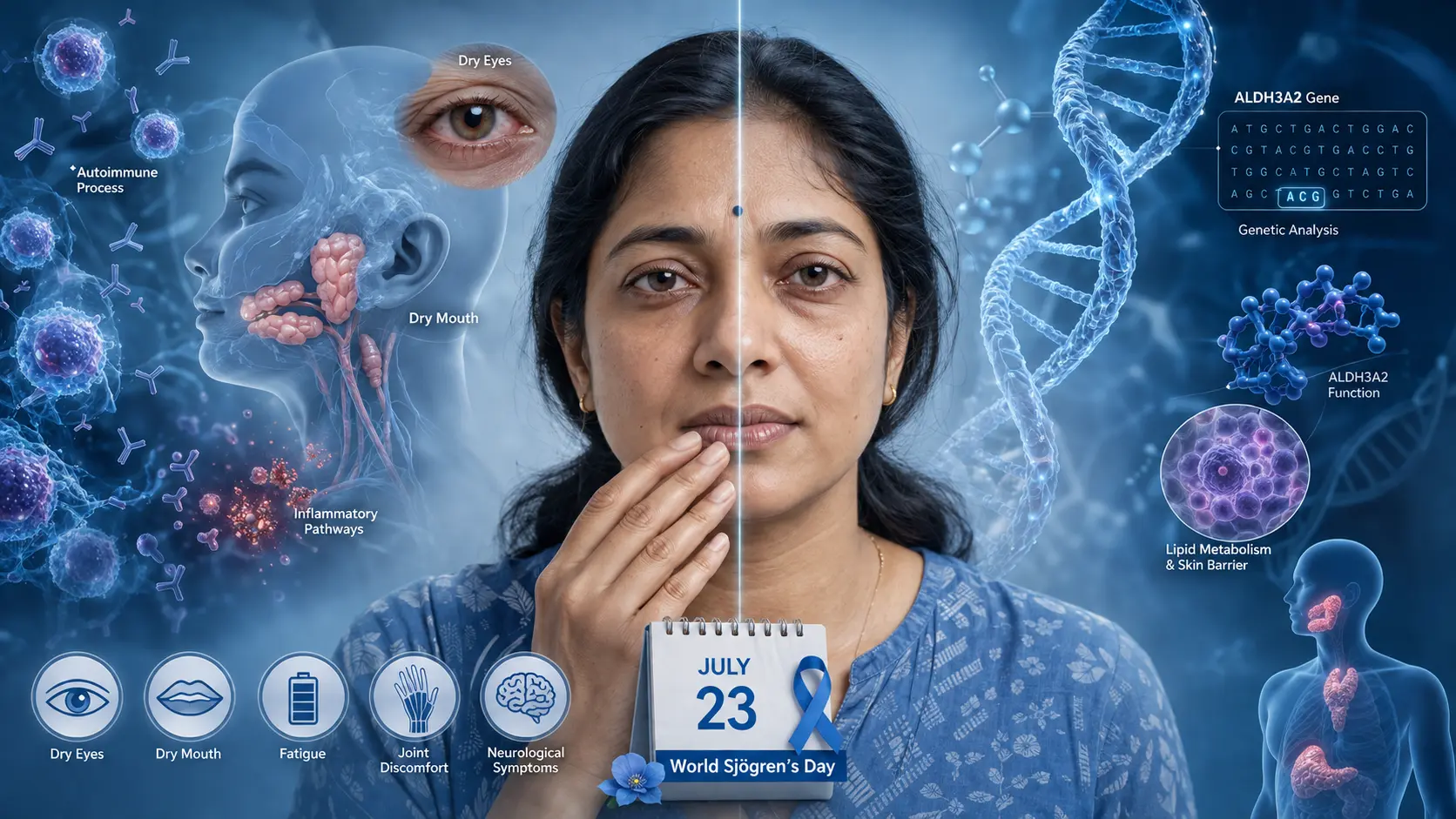
World Sjögren’s Day 2026 is observed on July 23, providing an opportunity to raise awareness about a frequently overlooked autoimmune condition that can affect more than just the eyes and mouth. While persistent dry eyes and dry mouth are its best-known symptoms, Sjögren’s disease may also involve the joints, skin, lungs, kidneys, nervous system and other organs. Recognising the early warning signs can help people seek appropriate medical evaluation soonerWhat Is Sjögren’s Disease?
Sjögren’s disease—formerly commonly called Sjögren’s syndrome—is a systemic autoimmune disease. The immune system mistakenly targets tissues involved in producing moisture, particularly the glands responsible for tears and saliva.
The result can be:
- Persistent dry eyes
- Dry mouth
- Difficulty swallowing dry foods
- Increased dental cavities and oral infections
- Joint and muscle pain
- Persistent fatigue
- Dry skin
- Vaginal dryness
- Chronic dry cough
- Numbness or tingling in some individuals
Not everyone experiences the same symptoms. Some people have predominantly eye and mouth symptoms, while others may develop symptoms affecting multiple organs.
The disease can also occur alongside other autoimmune conditions, including rheumatoid arthritis and lupus, making recognition and diagnosis more complex.s Sjögren’s Disease Genetic?
This is one of the most important questions surrounding Sjögren’s disease.
The short answer is: genetics may contribute to susceptibility, but Sjögren’s disease is not generally considered a straightforward single-gene inherited disorder.
Researchers believe that Sjögren’s disease develops through a complex interaction between:
- Genetic susceptibility
- Immune-system regulation
- Environmental influences
- Possible infectious triggers
- Other biological factors
Several genes have been associated with immune regulation and susceptibility to autoimmune diseases. However, having a genetic variant associated with increased susceptibility does not automatically mean that a person will develop Sjögren’s disease.
This is an important distinction between genetic predisposition and genetic diagnosis.
Genetic Risk vs. Genetic Disease: What’s the Difference?
A genetic risk factor may increase a person’s susceptibility to a complex condition. It usually does not determine the outcome by itself.
A genetic disease, on the other hand, may result from a specific pathogenic variant or mutation in a particular gene and can follow a recognisable inheritance pattern.
This distinction becomes particularly important when discussing Sjögren’s disease alongside rare inherited disorders that have similar names.
Sjögren’s Disease vs. Sjögren-Larsson Syndrome: Why the Names Matter
Despite their similar names, Sjögren’s disease and Sjögren-Larsson syndrome are different medical conditions.
Sjögren’s Disease
Sjögren’s disease is primarily a systemic autoimmune disorder. It is associated with immune-system dysfunction and commonly causes dry eyes and dry mouth, although other organs may also be affected.
Sjögren-Larsson Syndrome
Sjögren-Larsson syndrome (SLS) is a rare inherited metabolic disorder caused by pathogenic variants in the ALDH3A2 gene. It has a very different biological mechanism and clinical presentation from autoimmune Sjögren’s disease.
SLS is typically associated with features such as:
- Congenital or early-onset ichthyosis (dry, scaly skin)
- Neurological abnormalities
- Spasticity
- Developmental or intellectual disability in some individuals
- Characteristic retinal changes
Because these are distinct conditions, an ALDH3A2 genetic test is relevant to the evaluation of suspected Sjögren-Larsson syndrome, not as a routine genetic test for common autoimmune Sjögren’s disease.
This distinction is particularly important when interpreting genetic testing information or searching online for “Sjögren’s genetic tests.”
Early Symptoms of Sjögren’s Disease You Should Not Ignore
Symptoms can develop gradually, which is one reason Sjögren’s disease may be overlooked.
1. Persistent Dry Eyes
Dryness that continues despite adequate rest or hydration may be more than a temporary irritation.
Some people describe:
- Burning
- Itching
- A gritty or sandy sensation
- Light sensitivity
- Blurred vision
Persistent eye dryness should be evaluated by an appropriate healthcare professional, particularly when accompanied by other systemic symptoms.
2. Ongoing Dry Mouth
A dry mouth may cause:
- Difficulty swallowing dry foods
- Frequent thirst
- Changes in taste
- Difficulty speaking for long periods
- Increased dental problems
Saliva plays an important protective role in oral health. Reduced saliva can increase the risk of cavities and oral infections.
3. Unexplained Fatigue
Fatigue is often dismissed as stress, poor sleep or a busy lifestyle. However, persistent or disproportionate fatigue—particularly when combined with dryness, joint pain or other symptoms—may warrant medical assessment.
4. Joint and Muscle Pain
Some individuals with Sjögren’s disease experience joint or muscle discomfort. These symptoms may overlap with other autoimmune and rheumatological conditions, making a comprehensive clinical evaluation important.
5. Dry Skin or Other Dryness
Dryness may extend beyond the eyes and mouth. Some individuals experience dry skin or vaginal dryness.
6. Numbness, Tingling or Neurological Symptoms
Sjögren’s disease can sometimes involve the nervous system. New or unexplained numbness, tingling or other neurological symptoms should be discussed with a healthcare professional rather than automatically attributed to ageing or lifestyle.
Recent clinical guidance has placed greater emphasis on recognising and evaluating peripheral nervous system manifestations in people with Sjögren’s disease.
Can Genetic Testing Help With Sjögren’s-Related Concerns?
Genetic testing can be valuable when a clinician suspects an inherited disorder, particularly when symptoms begin early in life, there is a strong family history, or the clinical presentation suggests a specific genetic syndrome.
However, genetic testing should be selected according to the clinical question.
For example:
- Suspected autoimmune Sjögren’s disease → clinical and autoimmune evaluation is central.
- Suspected Sjögren-Larsson syndrome → ALDH3A2-related genetic testing may be relevant.
- Suspected broader inherited disease → a clinician may consider a wider genetic testing strategy based on the individual’s symptoms and family history.
This distinction helps prevent a common misunderstanding: not every condition with “Sjögren” in its name is genetically tested in the same way.
If an inherited condition such as Sjögren-Larsson syndrome is suspected, molecular genetic testing can help identify disease-causing variants in the ALDH3A2 gene, supporting diagnosis and potentially helping with genetic counselling for affected families.
https://dnalabsindia.com/test/aldh3a2-gene-sjogren-larsson-syndrome-ngs-genetic-dna-test
Frequently Asked Questions
1. What is Sjögren’s disease?
Sjögren’s disease, also known as Sjögren’s syndrome, is a systemic autoimmune condition in which the immune system attacks moisture-producing glands. It commonly causes dry eyes and dry mouth but may also affect the joints, skin, lungs, kidneys, nervous system and other organs.
2. Is Sjögren’s disease genetic?
Sjögren’s disease is not usually caused by a single inherited gene mutation. Genetic factors may contribute to a person’s susceptibility, but the condition is considered complex and may involve interactions between genetic predisposition, immune-system dysfunction and environmental factors.
3. What are the early symptoms of Sjögren’s disease?
Common early symptoms include persistent dry eyes, dry mouth, unexplained fatigue, joint or muscle pain, dry skin and increased dental problems. Some individuals may also experience neurological symptoms such as numbness or tingling.
4. Can Sjögren’s disease be diagnosed with a genetic test?
There is no single genetic test that routinely diagnoses autoimmune Sjögren’s disease. Diagnosis typically involves a combination of medical history, physical examination, blood tests, eye and salivary gland evaluations and other investigations based on symptoms.
5. What is Sjögren-Larsson syndrome?
Sjögren-Larsson syndrome is a rare inherited metabolic disorder that is different from autoimmune Sjögren’s disease. It is caused by pathogenic variants in the ALDH3A2 gene and is typically associated with ichthyosis, neurological abnormalities and other characteristic clinical features.
6. Are Sjögren’s disease and Sjögren-Larsson syndrome the same condition?
No. Despite having similar names, they are distinct medical conditions. Sjögren’s disease is primarily an autoimmune disorder, while Sjögren-Larsson syndrome is a rare inherited disorder caused by changes in the ALDH3A2 gene.
7. What is the ALDH3A2 gene test used for?
An ALDH3A2 genetic test may be used when a healthcare professional suspects Sjögren-Larsson syndrome. The test looks for disease-causing variants in the ALDH3A2 gene that can support a diagnosis when interpreted alongside the individual’s clinical features and family history.
8. Who should consider genetic testing for Sjögren-Larsson syndrome?
Genetic testing may be considered for individuals with clinical features suggestive of Sjögren-Larsson syndrome, particularly when symptoms such as early-onset ichthyosis and neurological abnormalities are present or when there is a relevant family history. Testing decisions should be guided by a qualified healthcare professional or genetic counsellor.
9. How is Sjögren’s disease managed?
Management depends on the symptoms and organs affected. It may include treatments for dry eyes and dry mouth, preventive dental care, symptom management and medications for systemic disease when necessary. Regular medical monitoring may be recommended for individuals with organ involvement.
10. When should I see a doctor for possible Sjögren’s disease?
You should consider medical evaluation if you have persistent dry eyes or dry mouth, unexplained fatigue, joint pain, recurrent dental problems or other symptoms that continue without an obvious cause. A doctor can determine whether further evaluation for Sjögren’s disease or another condition is appropriate.
https://dnalabsindia.com/test/aldh3a2-gene-sjogren-larsson-syndrome-ngs-genetic-dna-test

