
Down syndrome, also known as Trisomy 21, is the most common chromosomal condition diagnosed in India and worldwide . It is a genetic disorder caused by the presence of an extra copy of chromosome 21, which affects a person’s physical and cognitive development. This comprehensive guide provides detailed clinical information about Down syndrome, including its causes, types, associated health considerations, and the definitive diagnostic methods used for confirmation.
What is Down Syndrome (Trisomy 21)?
Humans typically have 46 chromosomes in each cell, arranged in 23 pairs. In Down syndrome, there is a complete or partial extra copy of chromosome 21, bringing the total to 47 chromosomes . This extra genetic material is responsible for the characteristic features and developmental patterns associated with the condition.
Down syndrome is not a disease or an illness, but a naturally occurring chromosomal variation. It affects people of all races, nationalities, and socioeconomic backgrounds equally .
Incidence in India
The prevalence of Down syndrome in India varies by region, with estimates ranging from 1 in 700 to 1 in 1,800 live births . India sees approximately 30,000 to 40,000 babies born with Down syndrome every year . A 2025 study in the Journal of Fetal Medicine found that first-trimester combined screening (cFTS) detected trisomy 21 with high sensitivity (94.74%) in women of advanced maternal age, underscoring the value of early screening even in a country with diverse healthcare access .
The Three Types of Down Syndrome
Understanding the genetic basis of Down syndrome is important for diagnosis and family planning. The condition can occur in three distinct forms :
1. Complete Trisomy 21 (Nondisjunction)
- Prevalence: Accounts for approximately 95% of all cases.
- Mechanism: A random error in cell division called “nondisjunction” occurs during the formation of the egg or sperm . This results in a reproductive cell with an extra copy of chromosome 21. When this cell contributes to conception, every cell in the resulting embryo will have 47 chromosomes .
- Maternal Origin: In the majority of cases, the extra chromosome comes from the mother’s egg .
- Inheritance: This type is almost always a random event and is not inherited.
2. Translocation Trisomy 21
- Prevalence: Accounts for approximately 3-4% of cases.
- Mechanism: An extra part or whole copy of chromosome 21 becomes attached (translocated) to another chromosome . The most common translocation is between chromosomes 14 and 21: t(14;21) . While the person has 46 chromosomes, they effectively have three copies of chromosome 21 material.
- Inheritance: This is the only form that can be inherited. About half of the cases are de novo (new mutations), while the other half are inherited from a parent who is a “balanced carrier” (they carry the translocation without having Down syndrome themselves) .
- Parental Risk: If the mother is a carrier of the t(14;21) translocation, the risk of having a child with Down syndrome is theoretically about 1 in 3, but closer to 1 in 10 in practice. If the father is the carrier, the risk is about 1 in 20 . For a rarer translocation (21q;21q), a carrier parent has a 100% chance of having a child with Down syndrome .
3. Mosaic Trisomy 21
- Prevalence: Accounts for approximately 1-2% of cases .
- Mechanism: The error in cell division occurs after fertilization, during the early development of the embryo . This results in a person having two different cell lines: some cells with the normal 46 chromosomes and some with 47 chromosomes (including the extra copy of chromosome 21) .
- Presentation: The clinical features of mosaic Down syndrome can be highly variable and are often milder, depending on the proportion of cells affected and the tissues involved . This can make prenatal diagnosis more challenging.
What Causes the Extra Chromosome?
Down syndrome is not caused by anything a parent did or did not do before or during pregnancy . The extra chromosome occurs by chance due to a random error in cell division. While advanced maternal age (particularly over 35) is associated with a higher risk of nondisjunction, it is important to note that 80% of children with Down syndrome are born to parents under the age of 35 . This is simply because younger women have more children overall.
Recognizing Down Syndrome: Signs and Associated Conditions
The features of Down syndrome can vary significantly from person to person. Some individuals may have mild features, while others may have more pronounced characteristics and associated health conditions. The diagnosis is usually suggested by physical appearance after birth and confirmed by a blood test.
Physical Characteristics
While not every individual will have all of these features, common physical signs include :
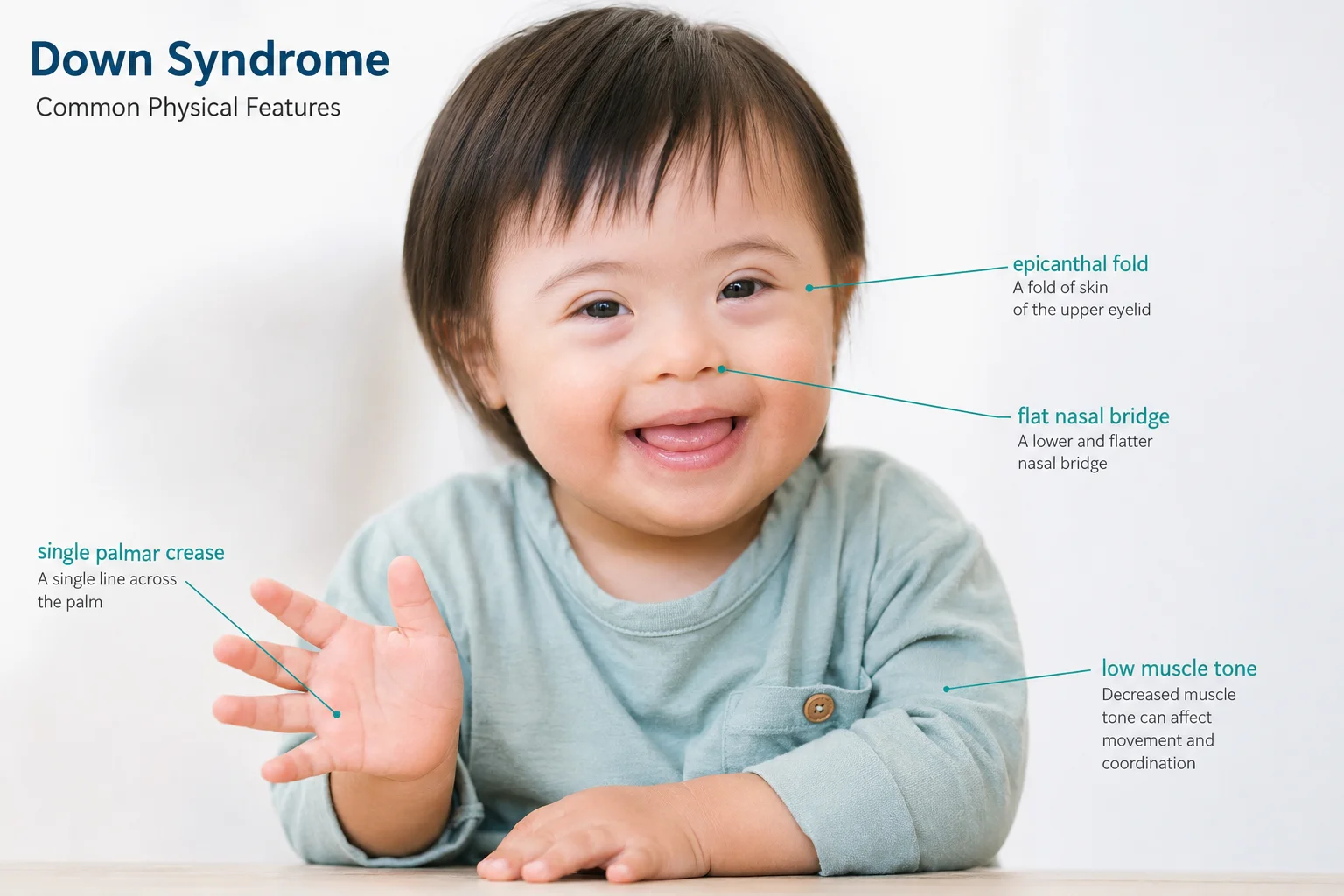
- Facial Features: A flattened facial profile and bridge of the nose, upslanting palpebral fissures (eyes), epicanthal folds (skin folds at the inner corners of the eyes), small and low-set ears, and a small mouth with a protruding tongue.
- Head and Neck: A smaller than average head (microcephaly) and a short neck with extra skin at the back (redundant nuchal folds).
- Hands and Feet: Short, broad hands with a single transverse palmar crease, short fingers with incurving of the fifth finger (clinodactyly), and a wide gap between the first and second toes (“sandal gap”) . A doctor can help you understand whether a chromosome analysis (karyotype) test is recommended to investigate these clinical signs.
- Muscle Tone: Poor muscle tone (hypotonia), which is often noticeable in infancy.
Associated Health Conditions
People with Down syndrome have an increased risk for certain medical conditions . Regular monitoring and early intervention are crucial.
- Congenital Heart Defects: About 50% of children with Down syndrome are born with a heart defect, most commonly ventricular septal defect (VSD) or atrioventricular septal defect (AVSD) .
- Gastrointestinal Issues: Approximately 6% are born with gastrointestinal anomalies, such as duodenal atresia. There is also an increased risk of Hirschsprung disease and celiac disease .
- Endocrine Disorders: Hypothyroidism (underactive thyroid) is very common, and there is an increased risk of diabetes .
- Hearing and Vision: Most individuals have some degree of hearing loss, and about 60% have eye problems, including cataracts, glaucoma, and strabismus .
- Other Conditions: There is an elevated risk of leukemia, infections, and obstructive sleep apnea . Joint instability in the neck (atlantoaxial instability) is also a concern.
The Role of Genetic Testing in Diagnosis
Accurate diagnosis is the first step towards appropriate medical management. There are different types of genetic tests available, and a doctor or genetic counselor can help determine which is most appropriate.
Karyotyping: The Gold Standard
A chromosome analysis or karyotype test is a blood test that provides a visual picture of all an individual’s chromosomes, arranged in pairs . This is the definitive test for confirming Down syndrome.
- Procedure: A blood sample is taken, and white blood cells are cultured in a lab to stimulate cell division. The cells are then treated, stained, and examined under a microscope.
- Purpose: Karyotyping can identify the presence of an extra chromosome 21 (confirming trisomy 21), detect structural changes like translocations, and distinguish between complete trisomy 21 and mosaic Down syndrome . It is considered the gold standard for diagnosing Down syndrome because it gives a complete picture of the chromosomes.
- Important Note: It is also the best tool for differentiating between mosaic and non-mosaic forms of Down syndrome. Government agencies like the US Social Security Administration specify that only a karyotype report is sufficient to establish non-mosaic Down syndrome for disability benefits, as a FISH test does not reliably distinguish between the two forms . You can visit the chromosome analysis (karyotype) test page to learn more about its clinical application.
FISH (Fluorescence In Situ Hybridization)
This is a rapid molecular test that can detect the presence of extra copies of specific chromosomes, such as chromosome 21 .
- Procedure: It uses fluorescent probes that bind to specific DNA sequences on chromosomes.
- Purpose: FISH is faster than karyotyping (results in 1-3 days) and is often used for rapid prenatal diagnosis .
- Limitations: Unlike karyotyping, FISH does not provide a full picture of all chromosomes and is not suitable for detecting mosaic Down syndrome or structural rearrangements like translocations . It is considered a screening tool that should ideally be followed up by karyotyping for a complete diagnosis.
Prenatal Screening and Diagnosis
For expectant mothers, Down syndrome can be screened for before birth. The Non-Invasive Prenatal Testing (NIPT) page on the DNA Labs India blog provides a detailed guide. For a confirmed diagnosis, invasive procedures like Chorionic Villus Sampling (CVS) or amniocentesis are used, with the sample cells being analyzed via karyotyping or FISH.
Living with Down Syndrome: A Focus on Abilities and Support
While Down syndrome is a lifelong condition, it is not a disease to be “cured.” The focus is on maximizing potential and quality of life.
Quality of Life and Life Expectancy
- Development: Children with Down syndrome typically experience delays in physical and cognitive development. Early intervention programs, including physical, occupational, and speech therapy, are vital for helping them achieve their milestones.
- Life Expectancy: The average life expectancy has increased dramatically over the past few decades, from around 25 years in the 1980s to approximately 60 years today, with some individuals living into their 80s . However, there is a higher risk of early-onset Alzheimer’s disease and dementia in adults with Down syndrome .
- Comprehensive Care: Management requires a multidisciplinary team to screen for and treat associated conditions. A doctor can guide you on the best approach for managing the health conditions associated with Down syndrome .
Conclusion: The Importance of Accurate Diagnosis
Understanding the genetic basis of Down syndrome is crucial for medical management and family planning. While the condition arises from a random chromosomal event, having a definitive diagnosis is the first step towards providing the best possible care and support.
If you or a family member have been recommended for chromosomal testing, the chromosome analysis (karyotype) is the definitive test that provides the comprehensive picture needed for an accurate diagnosis.

