
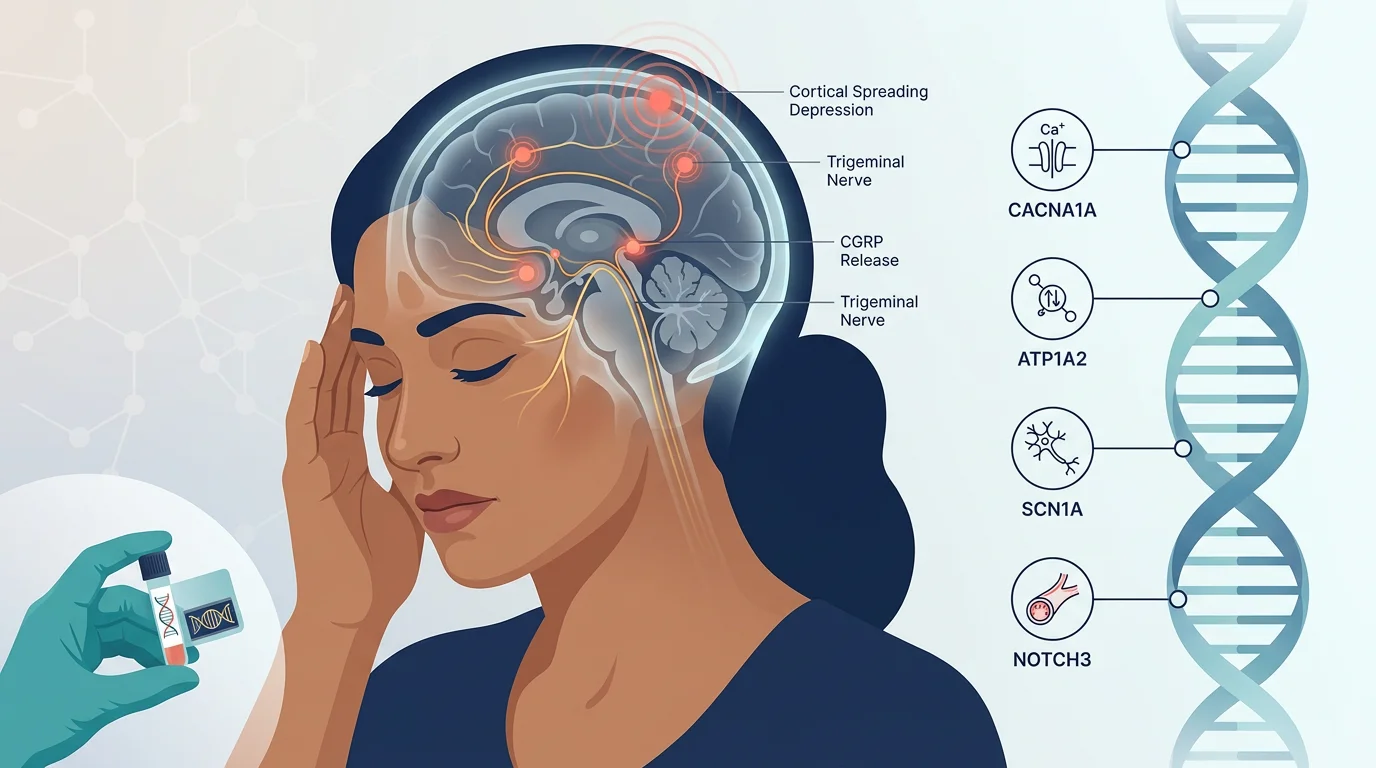
Migraine is not “just a bad headache.” It is a complex neurovascular disorder with distinct subtypes, well-mapped genetic risk factors, and — over the last decade — some of the most significant treatment breakthroughs in neurology. This piece covers the clinical classification of migraine, what’s happening at the molecular level, current treatment and lifestyle management, the latest advancements in therapy, and what genetic research is now revealing about who gets migraine and why.
1. What Is Actually Happening During a Migraine
Migraine is currently understood as a disorder of the trigeminovascular system — the network connecting the trigeminal nerve to the blood vessels of the meninges (the membranes covering the brain). An attack unfolds as a cascade:
- Cortical spreading depression (CSD): A wave of neuronal and glial depolarization moves across the cortex, thought to underlie the aura phase in some patients.
- Trigeminal activation: Sensory neurons release neuropeptides — most importantly calcitonin gene-related peptide (CGRP) — that trigger inflammation and dilation of blood vessels in the meninges.
- Central sensitization: Pain-processing neurons in the brainstem and thalamus become hypersensitive, which is why light, sound, and even scalp touch become unbearable during an attack.
This CGRP-centered model is the single biggest reason migraine treatment has been transformed in the last ten years.
2. Types of Migraine
Migraine is not one disease — it’s a spectrum of related disorders classified by the International Classification of Headache Disorders (ICHD-3).
Migraine Without Aura
The most common form (roughly 70-75% of cases). Recurrent attacks of moderate-to-severe, usually one-sided, pulsating pain lasting 4-72 hours, accompanied by nausea and sensitivity to light/sound.
Migraine With Aura
Around 25-30% of patients experience transient neurological symptoms before or during the headache — visual disturbances (zigzag lines, flashing lights, blind spots), sensory symptoms (tingling, numbness), or speech disturbances, typically lasting 5-60 minutes.
Hemiplegic Migraine (Familial and Sporadic)
A rare but clinically important subtype where aura includes temporary motor weakness on one side of the body — a feature that sets it apart from every other migraine type. This is also the most genetically well-defined form of migraine: three genes account for most identified familial hemiplegic migraine (FHM) cases, each corresponding to a distinct FHM subtype:
- CACNA1A — Familial Hemiplegic Migraine Type 1 (FHM1)
- ATP1A2 — Familial Hemiplegic Migraine Type 2 (FHM2)
- SCN1A — Familial Hemiplegic Migraine Type 3 (FHM3)
Because a hemiplegic migraine attack can closely mimic a stroke or transient ischemic attack (TIA), correctly identifying it — clinically and, where indicated, genetically — has real consequences for how urgently and how a patient is managed.
Chronic Migraine
Defined as headache on 15 or more days per month for at least three months, with migrainous features on at least 8 of those days. Chronic migraine carries a heavier disease burden and often needs a fundamentally different treatment strategy (preventive therapy, onabotulinumtoxinA, or CGRP-targeted prevention) than episodic migraine.
Vestibular Migraine
Recurrent episodes of vertigo or dizziness associated with migraine features, often under-recognized because patients present to ENT or neurology separately.
Menstrual Migraine
Triggered by the drop in estrogen just before menstruation; often more severe, longer, and less responsive to standard acute treatment than migraine at other points in the cycle.
Migraine With Brainstem Aura, Retinal Migraine, and Status Migrainosus
Rarer variants — brainstem aura involves symptoms like vertigo, dysarthria, or double vision; retinal migraine involves monocular visual disturbance; status migrainosus is a debilitating attack lasting beyond 72 hours requiring urgent management.
3. Causes and Triggers: Biology Meets Environment
Migraine arises from a combination of inherited neurological susceptibility and environmental/physiological triggers that lower the threshold for an attack.
Established biological contributors:
- Hyperexcitable cortical neurons (lower threshold for cortical spreading depression)
- Dysregulation of the trigeminovascular and CGRP pathway
- Hypothalamic involvement — explains premonitory symptoms like yawning, food cravings, and mood changes up to 48 hours before pain onset
- Serotonergic and dopaminergic pathway dysfunction
Common triggers (not causes, but attack precipitants in genetically susceptible individuals):
- Hormonal fluctuation (menstruation, ovulation, pregnancy, hormonal contraceptives)
- Sleep disruption — both deprivation and oversleeping
- Skipped meals / fasting-related blood sugar dips
- Dehydration
- Specific foods and additives (aged cheese, alcohol — especially red wine, MSG, artificial sweeteners, nitrates in processed/cured meats)
- Weather and barometric pressure changes
- Stress, and importantly, the let-down period after stress resolves
- Sensory overload — strong smells, bright or flickering light
Because triggers vary hugely between individuals, a personal trigger diary remains one of the most useful — and most underused — diagnostic tools in migraine management.
4. Standard Treatment: Acute and Preventive Care
Acute (Abortive) Treatment
- NSAIDs and combination analgesics for mild-to-moderate attacks
- Triptans (sumatriptan, rizatriptan, and others) — serotonin 1B/1D receptor agonists, effective for moderate-severe attacks but contraindicated in patients with cardiovascular risk
- Gepants (CGRP receptor antagonists) — an oral class (rimegepant, ubrogepant) that blocks the CGRP receptor directly, without the vasoconstrictive effects of triptans, making them safer for patients with cardiovascular disease
- Ditans (lasmiditan) — a serotonin 1F receptor agonist, effective without vasoconstrictive risk, though sedation is a common side effect
Preventive Treatment
- Traditional preventives repurposed from other conditions: beta-blockers, certain antiepileptics (topiramate, valproate), and tricyclic antidepressants
- OnabotulinumtoxinA (Botox) — approved specifically for chronic migraine, injected in a defined pattern around the head and neck every 12 weeks
- CGRP-targeted monoclonal antibodies — the major breakthrough of the last decade, covered in detail below
Neuromodulation Devices
Non-drug options are an increasingly important part of migraine management, particularly for patients who cannot tolerate medication: external trigeminal nerve stimulation, single-pulse transcranial magnetic stimulation, non-invasive vagus nerve stimulation, and remote electrical neuromodulation (worn on the upper arm).
5. Lifestyle Recommendations That Actually Move the Needle
Evidence-backed, non-pharmacological measures remain foundational, even alongside advanced drug therapy:
- Consistent sleep-wake timing — irregularity is a stronger trigger for many patients than short sleep duration alone
- Regular meal timing to avoid blood sugar dips
- Hydration — even mild dehydration measurably lowers migraine threshold in susceptible individuals
- Moderate, regular aerobic exercise — helps reduce attack frequency over time, though intense unaccustomed exercise can itself be a trigger
- Trigger diary tracking — food, sleep, stress, hormonal cycle, and weather logged against attack days to identify individual (not generic) triggers
- Stress-management practices — attacks often follow the drop in stress (weekend migraines), not just stress itself
- Limiting acute medication use — overusing triptans, NSAIDs, or combination analgesics (more than 10-15 days/month depending on the drug class) can itself cause medication-overuse headache, worsening the underlying condition
6. Advancements in Migraine Treatment
The CGRP-centered model of migraine has driven the biggest shift in treatment in decades, moving the field from purely symptomatic control toward mechanism-targeted therapy.
The CGRP monoclonal antibody era: CGRP has become such a well-validated therapeutic target that there are now eight monoclonal antibodies and small-molecule receptor antagonists approved by the US FDA for the acute and preventive treatment of migraine, and while these drugs have been remarkably safe overall in real-world use, some adverse effects are beginning to emerge as post-marketing data accumulates.
Ongoing real-world (Phase 4) research: Post-approval studies continue to refine how these therapies are used in practice. Recent Phase 4 clinical trials on rimegepant, an oral small-molecule CGRP receptor antagonist approved for both prevention and acute treatment of migraine, are generating additional real-world evidence beyond what the original approval studies showed.
Toward genetics-guided precision treatment: Research is increasingly exploring how genetics and epigenetics of the CGRP system interact with existing chronic migraine treatments like onabotulinumtoxinA, aiming to explain why some patients respond dramatically while others see little benefit — a step toward truly individualized migraine care rather than a one-size-fits-all treatment ladder. This connects directly to the pharmacogenomic findings discussed below, where specific genetic variants are now being linked to how well a patient responds to anti-CGRP therapy.
7. The Genetic Basis of Migraine
This is where migraine research has advanced dramatically. Migraine has a strong heritable component — first-degree relatives of migraine patients have roughly double the risk of developing migraine themselves, and twin studies estimate heritability at 40-60%.
Monogenic Forms: Familial Hemiplegic Migraine
FHM is caused by mutations in single genes with a clear, dominant inheritance pattern:
- CACNA1A (FHM1): Encodes a neuronal calcium channel subunit; mutations increase neuronal excitability and lower the threshold for cortical spreading depression.
- ATP1A2 (FHM2): Encodes a subunit of the Na+/K+-ATPase pump; mutations impair the clearing of potassium and glutamate from the synaptic space, promoting cortical spreading depression.
- SCN1A (FHM3): Encodes a neuronal sodium channel; mutations alter channel inactivation kinetics and neuronal firing.
These are the genes most relevant to targeted clinical genetic testing, particularly when hemiplegic migraine needs to be distinguished from stroke or other inherited small-vessel disorders that can present similarly — most notably CADASIL, caused by mutations in the NOTCH3 gene, which produces recurrent migraine-like headaches with aura alongside a distinct risk of early strokes and vascular dementia. Because the clinical overlap between FHM and CADASIL can be significant, NOTCH3 genetic testing is often considered alongside FHM panels when a patient’s family history includes both migraine and early-onset stroke or cognitive decline.
Polygenic Risk: Genome-Wide Association Studies (GWAS)
For the common forms of migraine (with and without aura), risk is polygenic — driven by the combined, small effects of many common variants rather than one causal gene. <cite index=”7-1″>A large genome-wide association study pooling genomic data from over 100,000 people with migraine and more than 770,000 controls identified 123 genetic variants associated with migraine, 86 of which had not been previously linked to the condition.</cite> <cite index=”7-1″>Notably, several of the newly discovered variants were located in genes that are also targets of migraine-specific drugs, including CGRP and the serotonin 1F receptor, and researchers also identified variants specific to migraine with aura versus migraine without aura.</cite>
More recent multi-omic work is going a layer deeper than GWAS hits. <cite index=”9-1″>Research integrating multi-omics, single-cell, and spatial transcriptomic data is now mapping how migraine’s genetic risk operates across neuroimmune and vascular tissue, aiming to define the precise tissue and cell types where common genetic risk acts.</cite> Separately, population-specific studies are starting to address a long-standing gap: <cite index=”6-1″>most genetic migraine studies to date have focused on European-ancestry populations, leaving a significant gap in understanding the genetic architecture of migraine in other ethnic groups, including Asian populations</cite> — a gap directly relevant to genetic risk assessment in the Indian population.
Pharmacogenomics: Genetics and Treatment Response
Genetics doesn’t just predict risk — it’s starting to predict treatment response. <cite index=”6-1″>A study in a Han Chinese population with chronic migraine identified six specific genetic variants significantly associated with response to anti-CGRP monoclonal antibody therapy, located in or near genes involved in neuronal development, DNA-dependent ATPase activity, and oxidation-reduction processes</cite> — with <cite index=”6-1″>the strongest of these being a variant in the LRRC4C gene</cite>. This is an early but important step toward genuinely personalized migraine prevention: using a patient’s genetic profile to predict which preventive therapy is most likely to work for them, rather than the current trial-and-error approach.
Separately, <cite index=”1-1″>a broader genetic analysis of migraine has implicated biological pathways including lipid accumulation, obesity, cholesterol metabolism, fatty acid levels, irritability, and neuroticism</cite>, <cite index=”1-1″>with migraine-associated genes found to be enriched in brain and uterine tissue</cite> — reinforcing both the neurological basis of migraine and the reason it disproportionately affects women. <cite index=”1-1″>The same research found genetic correlations between migraine and conditions like PTSD, depression, and traumatic brain injury, though causal (Mendelian randomization) analysis did not establish a direct causal relationship between them</cite> — an important distinction: shared genetic risk factors, not one condition directly causing the other.
8. Why the Genetic Picture Matters Clinically
For most people, migraine is diagnosed clinically — genetic testing is not part of routine care. But it becomes clinically meaningful in specific situations:
- Atypical presentations, particularly hemiplegic migraine, where distinguishing a genetic channelopathy (CACNA1A, ATP1A2, SCN1A) from a mimicking condition like stroke, TIA, or CADASIL (NOTCH3) changes acute management entirely
- Strong family history with early onset or unusual severity, where identifying a known FHM or CADASIL-associated variant can inform genetic counseling for the wider family
- Overlapping neurological red flags — for example, migraine-like headaches occurring alongside early strokes, transient neurological deficits, or a family pattern of vascular dementia, where a NOTCH3 evaluation can help clarify whether CADASIL is contributing to the picture
- Treatment-resistant chronic migraine, where pharmacogenomic research is moving toward using genetic markers to guide which preventive class (CGRP monoclonal antibody vs. gepant vs. onabotulinumtoxinA) is most likely to help
As pharmacogenomic research matures — including population-specific studies addressing the current underrepresentation of South Asian genetic data — genetic insight is likely to play a growing role in migraine management, moving the field from symptom-based treatment toward mechanism-based, individualized care.
Frequently Asked Questions
1. What are the main types of migraine? Migraine is classified into several distinct types under the ICHD-3 system: migraine without aura (the most common form), migraine with aura, hemiplegic migraine (a rare subtype involving temporary one-sided weakness), chronic migraine (15+ headache days a month), vestibular migraine (vertigo-predominant), menstrual migraine, and rarer forms like brainstem aura and retinal migraine.
2. What causes migraine at a biological level? Migraine originates in the trigeminovascular system, the network connecting the trigeminal nerve to blood vessels in the meninges. An attack involves cortical spreading depression, release of CGRP (calcitonin gene-related peptide) causing inflammation and vessel dilation, and central sensitization that makes light, sound, and touch painful.
3. What triggers a migraine attack? Common triggers include hormonal fluctuations, irregular sleep, skipped meals, dehydration, certain foods and additives (aged cheese, alcohol, MSG, nitrates), weather changes, stress and post-stress “let-down,” and sensory overload. Triggers vary significantly between individuals, which is why tracking a personal trigger diary is often more useful than following generic advice.
4. Is migraine genetic? Yes. Twin studies estimate migraine heritability at 40-60%, and first-degree relatives of migraine patients have roughly double the risk of developing it themselves. Hemiplegic migraine has the clearest genetic basis, caused by mutations in single genes (CACNA1A, ATP1A2, or SCN1A), while common migraine types involve the combined effect of over 100 genetic variants identified through genome-wide association studies.
5. What is hemiplegic migraine and how is it different from other types? Hemiplegic migraine is a rare subtype where the aura includes temporary weakness on one side of the body, in addition to typical migraine symptoms. Because this can resemble a stroke or TIA, correct identification matters clinically. It is also the most genetically well-defined migraine subtype, linked to mutations in the CACNA1A, ATP1A2, or SCN1A genes.
6. What is the role of CGRP in migraine treatment? CGRP (calcitonin gene-related peptide) is a neuropeptide central to migraine attacks. Targeting it has driven the biggest treatment advancement in decades: there are now eight FDA-approved CGRP-targeted monoclonal antibodies and receptor antagonists (gepants) for acute and preventive migraine treatment, offering an alternative to older therapies like triptans.
7. What are the latest advancements in migraine treatment? Recent advancements include CGRP monoclonal antibodies and oral gepants (rimegepant, ubrogepant), ongoing real-world (Phase 4) studies refining their long-term safety and efficacy, and early pharmacogenomic research linking specific genetic variants to how well a patient responds to anti-CGRP therapies — a step toward personalized migraine treatment.
8. When should someone consider genetic testing for migraine? Genetic testing isn’t part of routine migraine diagnosis, but it becomes clinically relevant in specific situations: atypical presentations like hemiplegic migraine that need to be distinguished from stroke or CADASIL, a strong family history of early-onset or severe migraine, or migraine occurring alongside early strokes or vascular dementia in the family, which may warrant evaluation for conditions like CADASIL (NOTCH3 gene).
9. How is hemiplegic migraine different from CADASIL? Both can cause migraine-like headaches with aura and run in families, which is why they’re sometimes confused. CADASIL, caused by mutations in the NOTCH3 gene, additionally carries a distinct risk of early strokes and vascular dementia, while familial hemiplegic migraine (linked to CACNA1A, ATP1A2, or SCN1A) does not typically involve this vascular and cognitive decline pattern. Distinguishing between them can involve targeted genetic testing.
10. Can migraine be cured? There is currently no cure for migraine, but it is highly manageable. Acute treatments (triptans, gepants, ditans, NSAIDs) address individual attacks, while preventive treatments (CGRP monoclonal antibodies, onabotulinumtoxinA, traditional preventives) and lifestyle measures (consistent sleep, hydration, trigger tracking) can significantly reduce attack frequency and severity over time.
This article is for informational purposes and does not replace consultation with a qualified neurologist. Diagnosis and treatment of migraine, particularly atypical or hemiplegic forms, should always involve appropriate clinical evaluation, and genetic testing should be pursued in consultation with a physician or genetic counsel

