

Cancer Genetic Tests Explained: Hereditary Panel, IHC & Liquid Biopsy
Quick Summary (BLUF)
- Sample Required: Blood or buccal swab (hereditary panel); tumor tissue (IHC/NGS); blood (liquid biopsy)
- Fasting Rules: No fasting required for any of these tests
- Turnaround Time (TAT): Hereditary panel: 10-14 days; IHC: 3-5 days; Tumor NGS: 7-10 days; Liquid biopsy: 5-7 days
- Base Cost: [Insert Current 2026 Price] per test
Written by: Dr. Ananya Sharma, MBBS, MD (Pathology)
Medically Reviewed by: Dr. Rajesh Kumar, MD (Medical Genetics)
Last Updated: February 2026
Most people encounter cancer genetic testing at the exact moment they're least equipped to evaluate it — after a scary diagnosis, a worrying scan, or a relative's illness. The result is confusion: is a "genetic test" the same as a "biopsy test"? Does a blood test replace a tissue sample? Can one test tell you everything?
It can't — and it isn't meant to. Modern oncology testing works because each test answers a different clinical question at a different point in the journey. Understanding that sequence is the single most useful thing a patient or caregiver in India can learn before their first appointment.
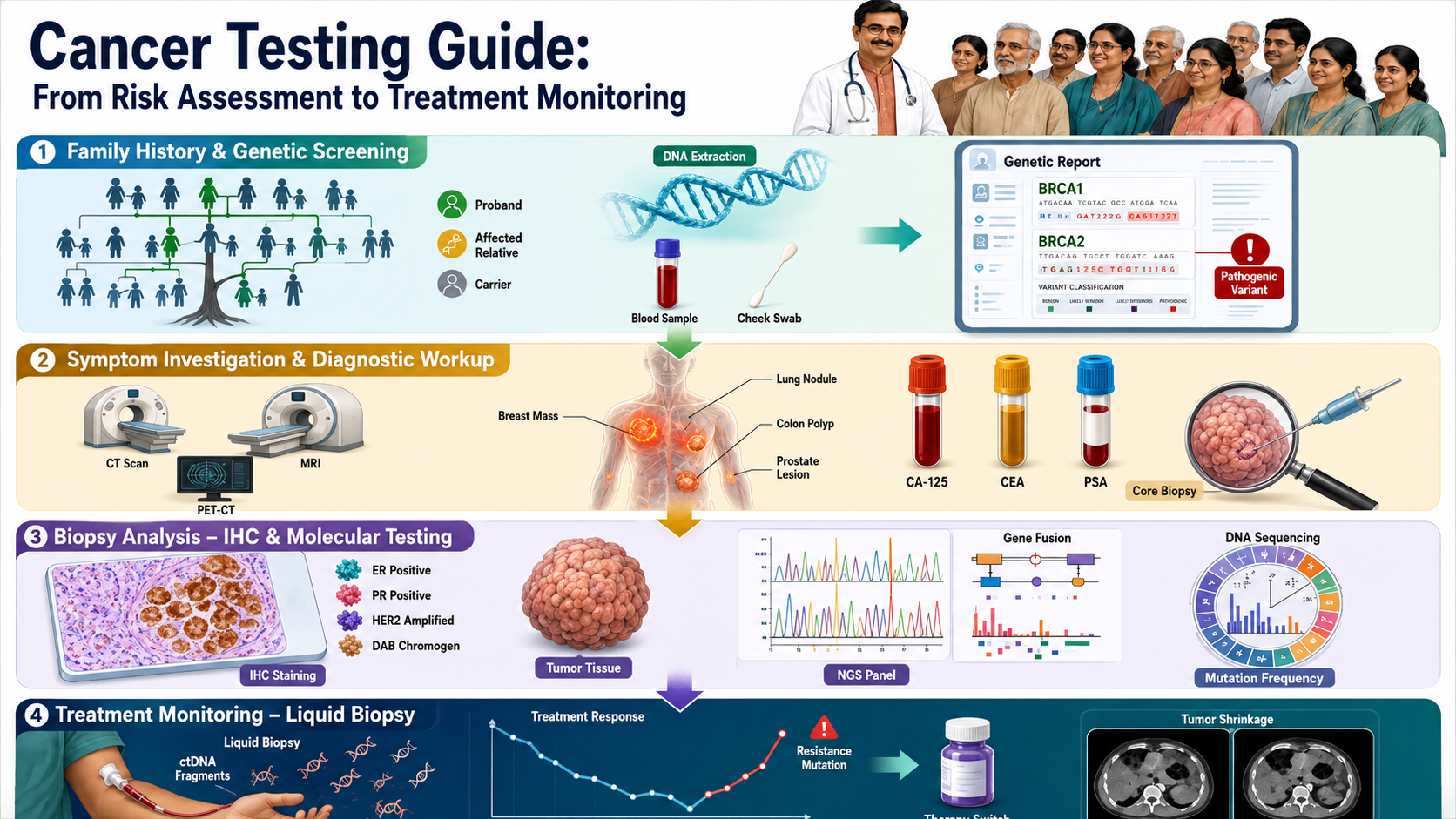
Inherited Risk Assessment: Germline Testing
The clinical question: "Did I inherit a gene that predisposes me to cancer?"
Roughly 5–10% of all cancers arise from a single inherited mutation passed down through a family line, rather than from lifestyle or chance alone. In Indian oncology practice, this pattern shows up distinctly: early-onset breast cancer clusters in some families by their 30s rather than the more typical post-menopausal presentation, and clinicians increasingly flag this generational shift as a reason to test proactively rather than reactively.
This is where germline testing — analysis of the DNA you were born with, not tumor DNA — comes in. A hereditary cancer risk panel sequences dozens of genes tied to hereditary syndromes (BRCA1/2, Lynch syndrome, Li-Fraumeni, and others) across multiple cancer types — breast, ovarian, colorectal, pancreatic, prostate, and more — rather than checking BRCA alone, since many Indian families carry non-BRCA pathogenic variants that a narrow test would miss entirely.
Why the result category matters more than the result itself
A hereditary panel doesn't return a simple yes/no. It returns one of three categories:
- Pathogenic variant found — risk is elevated, and this opens the door to earlier or more frequent screening, and to cascade testing for parents, siblings, and children.
- Negative — no currently known pathogenic variant, though family-based risk may still warrant clinical vigilance.
- VUS (Variant of Uncertain Significance) — a genetic change that hasn't yet been classified as harmful or benign. This is the result category most likely to be misread without genetic counseling, since a VUS is not a diagnosis of risk — it's an open question awaiting more data.
This is also why cascade testing matters so much in Indian joint-family structures: one positive result can reshape the screening plan for an entire extended family, not just the person tested.
Symptom Onset: Localizing Before Sampling
The clinical question: "Is this cancer, and where?"
A persistent cough, an unexplained lump, or a change in bowel habits triggers imaging (ultrasound, CT, MRI, PET-CT) and supportive blood markers first. Neither confirms cancer on its own — imaging shows where something looks abnormal, and marker levels can rise for non-cancerous reasons too. The only test that gives a definitive answer is a tissue biopsy. Everything that follows in the diagnostic pathway depends on that sample.
Biopsy Sample Analysis: Two Tests, Two Different Jobs
Once a pathologist confirms malignant cells under the microscope, two very different tests are typically ordered on the same tissue block — and mixing them up is one of the most common points of confusion for patients.
IHC: Identifying What the Cancer Cells Are Made Of
An Immunohistochemistry (IHC) panel works by applying antibodies to thin sections of the tumor tissue. Each antibody is designed to bind only to a specific protein; where it binds, a stain appears under the microscope. This lets a pathologist see the tumor's cell lineage and protein expression directly — which is especially critical when a cancer's tissue of origin isn't obvious from morphology alone, a scenario oncologists call a "tumor of unknown primary."
IHC is usually run first, immediately after malignancy is confirmed, because it's faster and answers the more fundamental question: what kind of cancer is this, biologically? For breast cancer, that means hormone receptor and HER2 status; for lymphomas, it distinguishes B-cell from T-cell origin; across several cancers, it can flag PD-L1 expression relevant to immunotherapy eligibility.
Tumor Panel: Finding the Exact Mutations to Target
A Comprehensive Tumor (NGS) Panel goes a layer deeper. Instead of proteins, it sequences the tumor's DNA directly — hundreds of cancer-associated genes at once — looking for the specific mutations, gene fusions, and copy-number changes actually driving that individual tumor's growth.
This is the test that makes targeted therapy possible. An EGFR mutation in lung cancer points toward an EGFR inhibitor; a BRAF V600E mutation opens the door to BRAF-targeted drugs; certain mismatch-repair gene findings (MLH1, MSH2, MSH6, PMS2) can indicate eligibility for immunotherapy. Because it's more detailed — and typically ordered for advanced, metastatic, or treatment-resistant disease — it's usually run alongside IHC rather than instead of it, not as a replacement for it.
The distinction in one line: IHC tells you what the cancer is; the tumor panel tells you what's driving it and what to aim a drug at.
Treatment Monitoring: Liquid Biopsy
The clinical question: "Is the tumor responding, and has resistance developed?"
Repeating a surgical biopsy every time an oncologist wants to check treatment response isn't practical — it's invasive, and tumors aren't always safely accessible for repeat sampling. This is the gap liquid biopsy is built for.
Tumor cells continuously shed fragments of their own DNA into the bloodstream as they divide and break down — this is called circulating tumor DNA (ctDNA). A liquid biopsy panel sequences these fragments from a blood draw, screening for the same actionable mutations covered by tissue-based tumor panels, without requiring a new tissue sample.
Two features make this particularly useful during treatment, rather than at initial diagnosis:
- Serial testing over time. Because ctDNA levels track with tumor burden, repeated draws across a treatment course can show a tumor shrinking, plateauing, or progressing — sometimes flagging relapse before it's visible on a scan.
- Resistance mutation detection. Cancers under drug pressure can acquire new mutations that make a once-effective therapy stop working. A liquid biopsy can catch this shift early, prompting a treatment change before symptoms return.
The honest limitation: in very early, small-volume tumors, there may not be enough ctDNA circulating to detect reliably. This is precisely why liquid biopsy is positioned as a monitoring tool for an already-diagnosed, established cancer — complementing tissue-based testing rather than substituting for it at first diagnosis.
Putting the Four Stages Together
| Stage | Clinical Question | Sample | Test |
|---|---|---|---|
| Family history, no symptoms | Did I inherit cancer risk? | Blood/buccal swab | Hereditary Cancer Risk Panel |
| Symptoms appear | Is this cancer, and where? | Imaging + blood markers | (guides need for biopsy) |
| Biopsy confirmed | What type of cancer is this? | Tumor tissue (FFPE) | IHC Comprehensive Panel |
| Biopsy confirmed, advanced disease | What mutations can I target? | Tumor tissue (FFPE) | Comprehensive Tumor Panel |
| On treatment | Is it working, or resistant? | Blood | Liquid Biopsy Panel |
No single test replaces this sequence — each one exists because the clinical question changes as the patient moves through diagnosis and treatment. Understanding which stage you're in is the first real step toward asking your oncologist the right question, and requesting the right test for it.
Frequently Asked Questions
1. What's the difference between a hereditary cancer panel and a BRCA test?
A standalone BRCA test only checks BRCA1 and BRCA2. A hereditary cancer panel sequences dozens of additional genes tied to inherited cancer syndromes — such as Lynch syndrome and Li-Fraumeni syndrome — across multiple cancer types. Since many families carry non-BRCA pathogenic variants, a broader panel is less likely to miss an inherited risk that a BRCA-only test would overlook.
2. What does a VUS (Variant of Uncertain Significance) result mean?
A VUS means a genetic change was found, but there isn't yet enough evidence to classify it as harmful or harmless. It is not a positive result and doesn't confirm elevated cancer risk — it's an open question that may be reclassified as more data becomes available. A VUS should always be discussed with a genetic counselor rather than interpreted on its own.
3. If one family member tests positive for a hereditary mutation, do other relatives need testing too?
Often, yes. This is called cascade testing — when a pathogenic variant is confirmed in one person, first-degree relatives (parents, siblings, children) may carry the same mutation and can benefit from knowing their own status, since it can change their screening schedule and preventive options.
4. Is IHC the same as a tumor (NGS) panel?
No — they test different things. IHC uses antibodies to detect specific proteins in the tumor tissue, revealing the cancer's cell lineage and biological subtype (for example, hormone receptor or HER2 status in breast cancer). A tumor NGS panel sequences the tumor's DNA directly to find the exact mutations driving its growth, which is what identifies targeted-therapy options. Many patients need both tests run on the same biopsy sample.
5. Can a liquid biopsy replace a tissue biopsy for diagnosis?
Generally, no. Liquid biopsy detects circulating tumor DNA (ctDNA) shed into the bloodstream, but very early or small tumors may not shed enough ctDNA to be reliably detected. It's primarily used to monitor an already-diagnosed cancer — tracking treatment response and catching resistance mutations — rather than to make an initial cancer diagnosis on its own.
6. How does liquid biopsy show whether treatment is working?
Because ctDNA levels in the blood tend to rise and fall with tumor burden, doctors can order liquid biopsy tests at intervals throughout treatment. A falling ctDNA level suggests the tumor is responding; a rising or newly-detected mutation can signal resistance or relapse — sometimes before it becomes visible on imaging.