
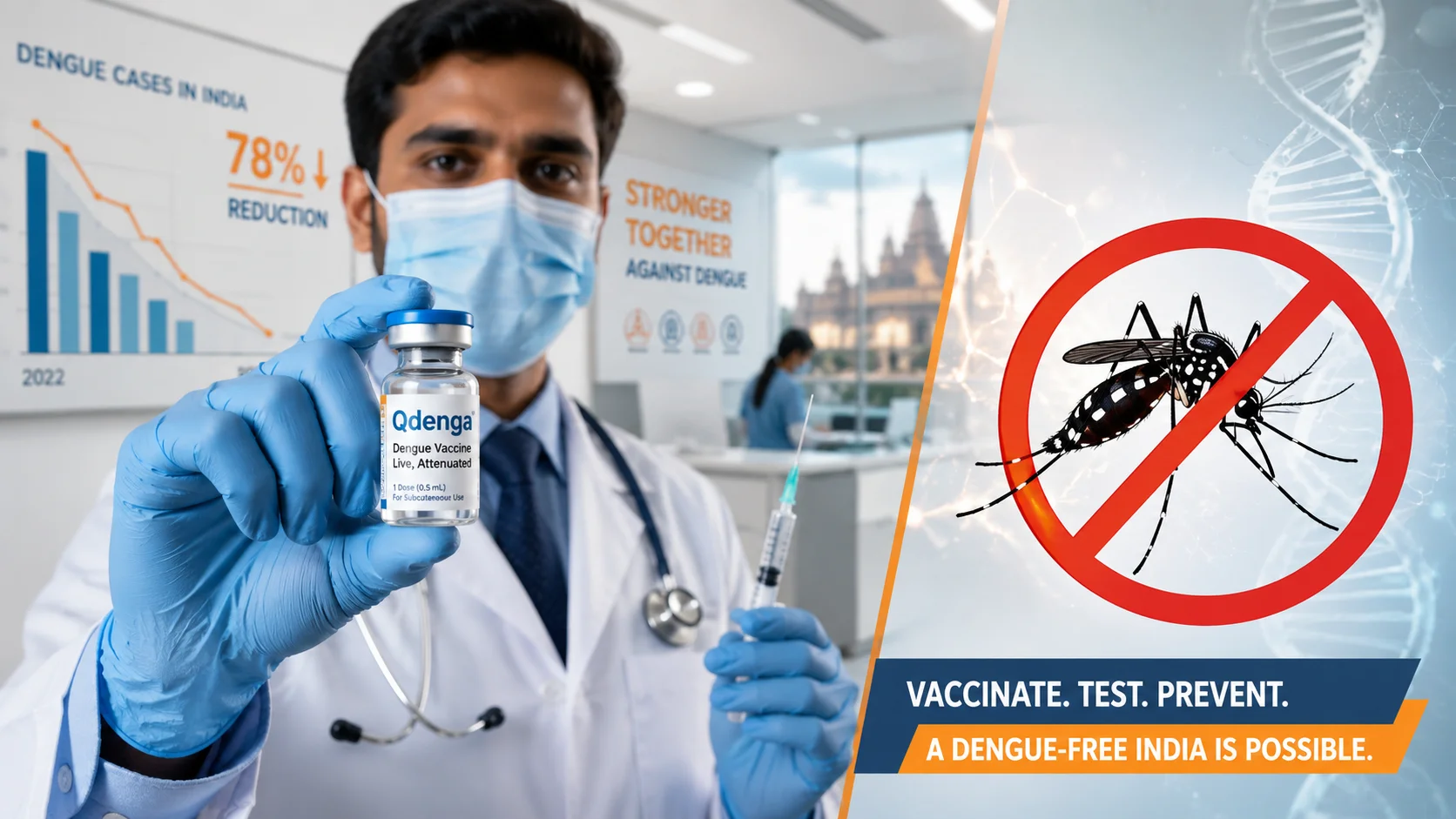
Understanding India’s First Approved Vaccine, Qdenga
For decades, dengue has been a formidable public health challenge in India, with the country accounting for nearly one-third of the global dengue burden . The monsoon seasons often bring a surge in cases, overwhelming hospitals and causing significant morbidity and mortality. In a landmark development, India’s drug regulator, the Central Drugs Standard Control Organisation (CDSCO), has granted market authorization to Takeda’s Qdenga, marking the first-ever dengue vaccine approved for use in the country . This blog post explores what this historic approval means, how the vaccine works, and why accurate diagnosis remains a cornerstone of dengue management.
A Milestone in India’s Fight Against Dengue
The approval of Qdenga comes at a critical time. Dengue cases in India have risen 11-fold over the past two decades . In 2024 alone, the World Health Organization reported over 232,000 cases and 233 deaths in India, part of a record global total of 14.4 million cases . The scale of the problem is immense, and while vector control measures are vital, the arrival of an effective vaccine adds a powerful new tool to the prevention arsenal.
Qdenga is a live-attenuated, tetravalent vaccine, meaning it is designed to protect against all four dengue virus serotypes (DENV-1, DENV-2, DENV-3, and DENV-4) . This is crucial because infection with one serotype does not provide immunity against the others, and a subsequent infection with a different serotype increases the risk of severe dengue.
The Science Behind Qdenga
The vaccine is administered as a two-dose schedule, with injections given three months apart, and is recommended for individuals aged 4 to 60 years . A key differentiator of Qdenga is that it can be used regardless of prior dengue exposure, eliminating the need for pre-vaccination testing . This simplifies its rollout and makes it suitable for broad use in endemic regions.
The approval is backed by robust clinical data. Takeda’s global clinical development program involved more than 28,000 participants across 19 trials . A local Phase 3 study in India involving 480 healthy adults confirmed the vaccine was “tolerated, safe, and immunogenic” . Long-term follow-up data from the TIDES study has demonstrated up to seven years of protection against dengue infection and related hospitalizations .
Efficacy and Safety Profile
The vaccine’s efficacy is impressive. In a late-stage trial, Qdenga showed 80.2% efficacy against confirmed dengue cases one year after the second dose and 90.4% efficacy against dengue-related hospitalizations after 18 months .
The regulatory approval, however, comes with a condition. Takeda is required to conduct a post-marketing safety and effectiveness study in the local population within six months of the vaccine’s introduction . This cautious approach reflects lessons learned from other dengue vaccines and ensures continued monitoring of its real-world performance.
How It Differs From Earlier Vaccines
The approval of Qdenga in India also distinguishes it from previous vaccines. Sanofi’s Dengvaxia, which is not approved in India, is recommended only for people with a prior dengue infection. In individuals without previous exposure, Dengvaxia was linked to an increased risk of severe dengue . Qdenga’s ability to be used without pre-vaccination testing circumvents this complex safety issue, making it a more practical and safer option for mass immunization.
Availability and Market Access
Takeda has confirmed that Qdenga is expected to be available in India in the first half of 2027, with initial availability through private healthcare settings . The company’s long-term goal is to make the vaccine broadly accessible, potentially through inclusion in national immunization programs . To support this, Takeda has partnered with Hyderabad-based Biological E. to manufacture up to 50 million doses annually in India, contributing to a global manufacturing capacity of 100 million doses by 2030 .
A Word on Expert Perspective
While the approval is a significant step, public health experts emphasize that vaccination is not a standalone solution. “Qdenga can help reduce disease severity and hospitalizations, but it is unlikely to prevent outbreaks as long as the mosquito vector continues to circulate,” noted Dr. Divya K.S., an infectious diseases specialist at Apollo Hospitals . Integrated strategies combining vaccination with robust vector control, surveillance, and community awareness remain essential for long-term dengue control .
The Role of Diagnosis: A Critical Complement
Even with a vaccine, accurate and timely diagnosis of dengue remains a cornerstone of clinical management. As the vaccine is not 100% effective and does not prevent all cases, diagnostic testing will continue to be vital for:
- Early Confirmation: Detecting the virus in the acute phase of illness.
- Clinical Management: Guiding treatment decisions and monitoring for severe complications like dengue hemorrhagic fever or dengue shock syndrome.
- Surveillance: Tracking circulating serotypes and disease burden.
Dengue Virus PCR Qualitative Test
At DNA Labs India, we provide the Dengue Virus PCR Qualitative Test, a molecular diagnostic tool that detects the presence of the dengue virus’s genetic material (RNA) in the blood. The PCR test is a preferred method of diagnosis because it can provide confirmed evidence of infection, especially during the first 7 days of illness when the virus is present in the bloodstream . According to the CDC, a positive NAAT (like RT-PCR) result confirms current dengue virus infection .
PCR vs. Serology Tests
| Feature | Dengue Virus PCR Test | Serology Tests (IgM/IgG) |
|---|---|---|
| What it Detects | Viral RNA (the virus itself) | Antibodies produced by the immune system |
| Optimal Timing | First 1-7 days of symptoms | After day 7 of symptoms |
| Interpretation | Positive result = Confirmed current infection | Differentiates between primary and secondary infection; indicates recent or past exposure |
| Advantage | Early diagnosis, highly specific | Useful after the acute viremic phase |
PCR testing is a powerful tool for early diagnosis. By detecting the virus directly, it allows for prompt clinical decision-making . While the vaccine is a future preventive measure, reliable diagnostic testing is a critical need for today’s dengue management.
Looking Ahead
The approval of Qdenga in India is a watershed moment in the country’s long battle against dengue. It offers a new, scientifically backed method to reduce the disease’s burden. However, its success will depend on a careful, phased rollout, robust post-market surveillance, and its integration into a comprehensive national strategy. For now, public health efforts must continue to focus on vector control, community engagement, and ensuring accessible, accurate diagnostic services like those offered at DNA Labs India.
1. What is Qdenga, and how does it work?
Answer: Qdenga is a live-attenuated, tetravalent dengue vaccine developed by Takeda. It is designed to protect against all four serotypes of the dengue virus (DENV-1, DENV-2, DENV-3, and DENV-4). The vaccine works by introducing a weakened version of the virus to stimulate the body’s immune system to produce a protective response without causing the disease. It is administered in two doses, three months apart.
2. Is the new dengue vaccine approved for use in India?
Answer: Yes, the Central Drugs Standard Control Organisation (CDSCO) has granted market authorization for Qdenga, making it the first dengue vaccine approved for use in India. It is expected to be available in the private healthcare sector in the first half of 2027, with a post-marketing safety study required within six months of its introduction.
3. Can I get the Qdenga vaccine if I have never had dengue before?
Answer: Yes, a key feature of Qdenga is that it can be used regardless of prior dengue exposure. This means you do not need to undergo pre-vaccination testing to determine if you have had a previous infection, simplifying its use compared to earlier vaccines. However, it is currently recommended for individuals aged 4 to 60 years.
4. Do I still need a dengue test if I get vaccinated?
Answer: Yes, diagnostic testing remains crucial even with vaccination. The vaccine is not 100% effective, and accurate diagnosis is still essential for early confirmation of infection, guiding clinical management, and monitoring for severe complications. For acute cases in the first 7 days of symptoms, a Dengue Virus PCR Qualitative Test is highly recommended.
5. What is the difference between a dengue PCR test and a serology test?
Answer: A dengue PCR test detects the virus’s genetic material (RNA) in the blood and is most effective during the first 1-7 days of symptoms, providing a confirmed diagnosis of a current infection. In contrast, serology tests (IgM/IgG) detect the body’s antibodies and are more useful after day 7 to determine if the infection is recent or past, helping differentiate between primary and secondary infections.
6. Where can I get a reliable dengue PCR test?
Answer: You can get a reliable and accurate Dengue Virus PCR Qualitative Test at DNA Labs India. The test uses advanced Real-Time PCR technology for early detection and is available at a discounted price with free home sample collection in over 400 cities across India, including Delhi, Mumbai, Bangalore, and Hyderabad.
Disclaimer: This blog post is for informational purposes only and does not constitute medical advice. The vaccine approval and rollout details are based on the latest available information and are subject to change. Please consult a qualified healthcare professional for any health concerns or before making any decisions related to vaccination or testing.

